


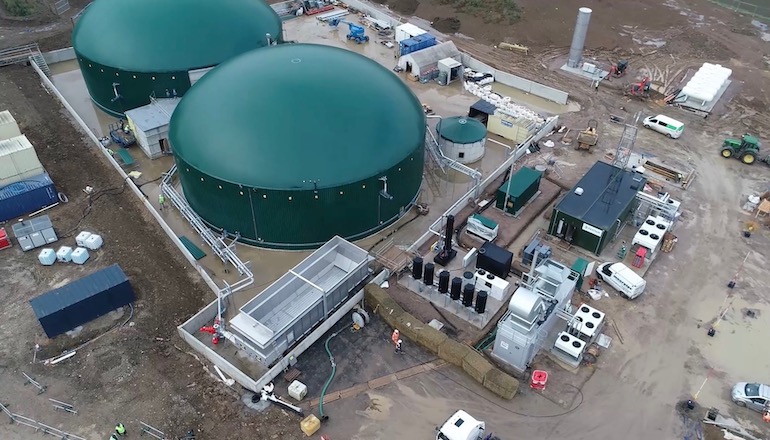
A new £14m anaerobic digestion plant has come online in Kent, England, producing both electricity and biomethane.
The plant, developed by Farm Renewables, on the Isle of Sheppey converts food and agricultural waste from the county into biogas and electricity.
It produces 500 cubic metres per hour of biomethane and 499 kilowatt-hours of electricity – half of which is used by the plant itself with the rest exported to the grid.
Malcolm McAllister from Farm Renewables said the project also produces a large amount of heat “which we’re planning to use to heat our landowner’s commercial grain storage and drying operation, greatly reducing the amount of diesel required”.
The plant will use 15,000 tonnes of maize, 6000 tonnes each of straw, chicken manure and fruit waste from the area each year to produce the renewable energy.
The digestate, which is a by-product of the anaerobic digestion process, will be spread on local arable fields, providing nutrients and organic matter to improve soil quality, reducing the reliance on artificial nitrogen-based fertilisers.
The plant also includes a unique straw processing unit to overcome challenges associated with having a large proportion of dry matter in the feedstock.
McAllister said: “This technology allows straw bales to be broken down, via a hammer mill into fine pieces which are then compacted and made into briquettes.
“Rather than using straw in its raw form, the uniformity of the briquettes aids the digestion process inside the plant helping increase efficiency and gas production per tonne of straw.”
Overall, the project cost £14.460m which came from specialist energy-from-waste funder Privilege Finance.
Privilege project lead Marc Graham said: We support projects that enable the development of local circular economies at an appropriate scale, so taking agricultural waste and fruit waste from within the area and using it to produce renewable energy for the national grid is a perfect fit.”