


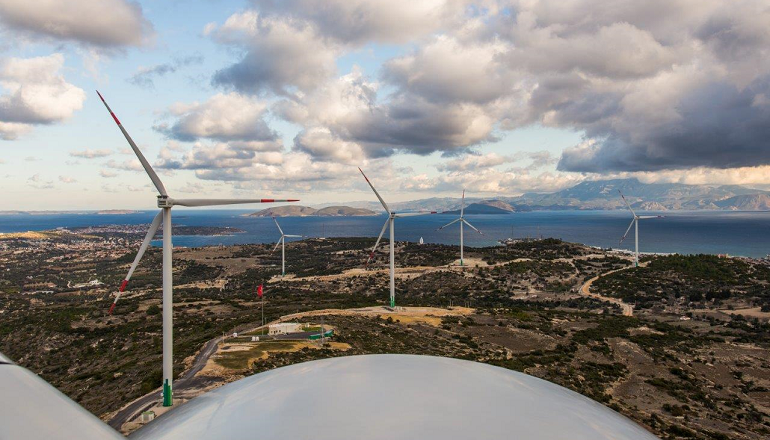
Nordex has manufactured one thousand towers for its turbines since introducing on-site assembly of these concrete structures in 2006.
Recently, the thousandth concrete tower, for an AW125/3000 turbine, left a specialised ‘mobile factory’ in Lagoa do Barro do Piaui, in Brazil, for the 595MW Lagoa dos Barros wind farm.
Based on the current order backlog for turbines in the AW platform, Nordex said it will manufacture a further thousand concrete towers by the end of 2020.
Nordex’s concrete tower segments are based on a mobile concept enabling these structures to be produced at the wind farm site, cutting logistics costs.
On-site tower construction can also help meet local content requirements in wind markets.
As wind auction markets grow, driving down wind costs, Nordex said using its concrete towers can help reduce costs of towers.
Concrete towers offer “additional advantages” compared to tubular steel towers, especially for hub heights of 100 metres or higher, said Nordex. Higher hub heights require larger diameters in the lower tubular steel segment for turbine towers.
As these steel components increase in size it makes transportation, by road, more challenging.
Concrete can also be produced locally.
Nordex’s concrete towers consist of 20 metre-long prefabricated convex segments that can be assembled on site when the wind farm is under construction, and can be stored vertically at the wind farm site until the nacelle is mounted.
Nordex Group now has 11 mobile manufacturing facilities worldwide, in Latin America, India, South Africa and Spain.
Each requires 250 staff to man and work in the facility.
Nordex offers concrete towers for the AW3000 turbines with hub heights of 80, 100, 120 and 140 metres, as well as for the N155/4.5 of the Delta4000 series, with a hub height of 120 metres.
The first Nordex turbine, an AW1500 machine, was installed on an 80-metre concrete tower in Spain.