


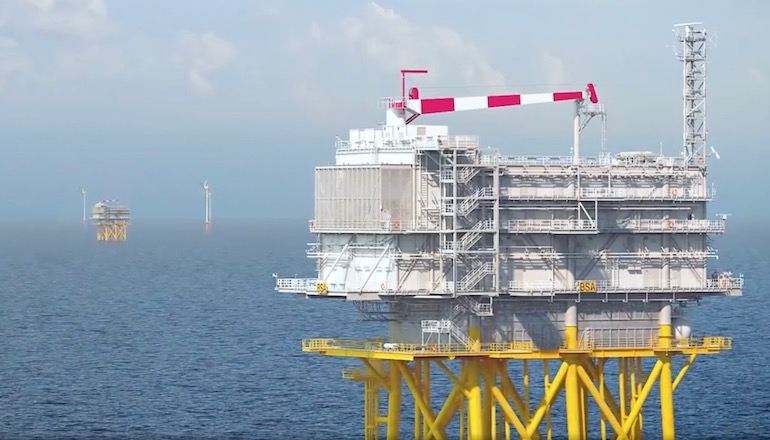
TenneT’s Borssele Alpha offshore wind grid connection in the Dutch North Sea is ready for operation, on time and within budget, according to the transmission system operator.
Certification issued by DNV GL marked the completion of the 700MW platform. TenneT said that ensures full compliance with conditions set out in the Dutch government’s Offshore Wind Energy Development Framework.
In 2020 the offshore wind farm Borssele 1&2, with a capacity of 700MW, which is being built by Orsted, will be ready to plug into Borssele Alpha.
Power generated by Borssele 1&2 will be connected through the grid connection to the onshore high voltage substation near Borssele for feeding into the high-voltage grid.
For this purpose, a new substation has been built next to the existing 380kV Borssele high voltage substation.
According to the Energy Agreement, by the end of 2023 TenneT will have constructed 3500MW of offshore grid connections for offshore wind farms.
The next offshore connection after Borssele Alpha is Borssele Beta, which will also have a capacity of 700MW and will be completed in 2020, serving the Borssele 3&4 wind complex, which is being developed by the Blauwwind consortium.
The following offshore wind farms to be built in the Dutch part of the North Sea include Hollandse Kust (zuid) and Hollandse Kust (noord).
TenneT will connect the wind farms off the coast of Zeeland, Zuid-Holland and Noord-Holland using the same standardised 700MW transformer platforms that are located close to the wind farms, and the same type of cable connection to the coast, enabling these projects to be completed more efficiently, more quickly and more economically.
TenneT’s manager for offshore projects in the Netherlands Marco Kuijpers said: “The integrated approach that was implemented on behalf of the Dutch government under the responsibility of the Ministry of Economic Affairs, the clear decisions concerning offshore wind energy locations, the innovations being adopted and TenneT’s standardised transmission systems are perfectly suited not only to the offshore wind programme up to the end of 2023, but also to the projects that have been planned to the end of 2030.”