


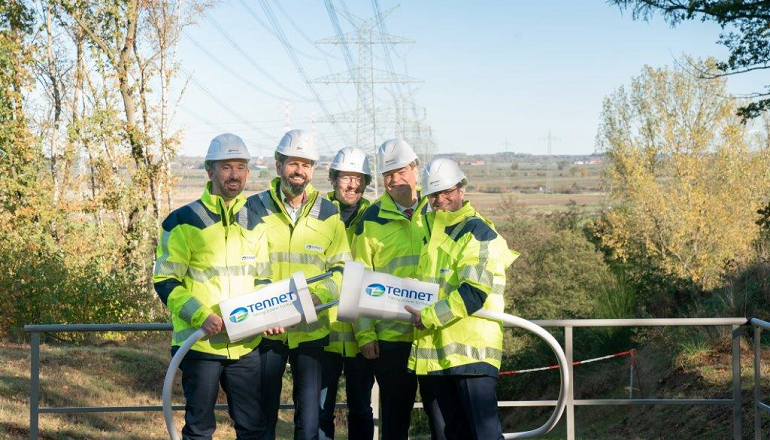
TenneT is calling for greater offshore wind ambition in Europe, during a visit by German minister Stephan Weil to the construction site of the 900MW BorWin5 offshore grid connection.
The grid operator’s managing director Tim Meyerjurgens said: “TenneT has now met and even significantly exceeded the Federal Government’s expansion targets for sustainable North Sea wind power.
“However, further efforts are needed to push ahead with the energy transition.
“According to all international studies and scenarios, the current rate of development in Europe is not enough for offshore wind to reach the goals of the Paris Climate Agreement for Europe. An accelerated, large-scale and internationally coordinated expansion is necessary.”
TenneT’s total offshore transmission capacity in the North Sea will exceed 7GW by the end of the year, above the German government’s target for the North and Baltic Seas of 6.5GW by 2020.
During his visit to BorWin5’s construction site on the North Sea island Norderney (pictured), Lower Saxony Prime Minister Weil said: “In both offshore and onshore we need more wind energy production in Lower Saxony in order to meet our climate targets for 2030 and in the long term until 2050.”
Weil also advocated the use of electricity-to-gas conversion and transmission.
“Northern Germany is predestined for a successful hydrogen economy and Lower Saxony is ready to realise the full potential of green hydrogen,” he said adding that the region already has the necessary infrastructure for storage, transport and distribution of large quantities of the gas.
As a member of the North Sea Wind Power Hub consortium, TenneT supports the objectives of the Paris Climate Agreement and the related commitments of the EU and the North Sea countries to reduce greenhouse gas emissions. In this context, in July TenneT presented a feasibility study on the implementation of wind energy distribution hubs in the North Sea.
“An internationally coordinated approach in the future could implement the connection and integration of a large expansion of offshore wind energy more effectively and at significantly lower costs of up to 30% compared with continued individual national planning,” Meyerjurgens said.
Since the North Sea has great potential for offshore wind energy, the implementation of 180GW of offshore wind can be achieved by 2045 if the consortium’s approach is adopted.
During his visit Weil saw the horizontal boreholes currently underway for laying empty conduits under the island, into which the submarine cables for the BorWin5 offshore grid connection, in order to continue to protect the sensitive natural environment of the island.
On the associated offshore converter platform BorWin Epsilon, the three-phase current generated at sea is converted into DC and is transported to Hilgenriedersiel with a submarine cable that crosses over Norderney, a distance of 125km.
The electricity is transmitted from land to Cloppenburg via a 125km underground cable.