


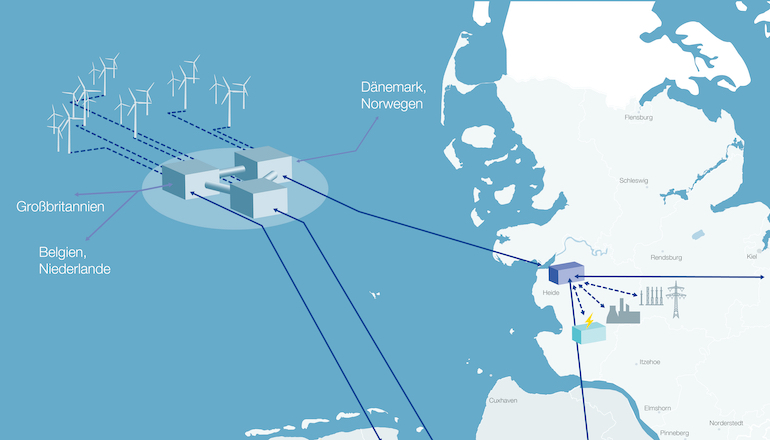
TenneT has unveiled what it calls a wind power booster concept for Germany to help unlock the potential of offshore wind in the North Sea.
The concept would be made up of three offshore network systems interconnected in such a way that 6GW of power would be bundled.
The network connection points are to be located in Schleswig-Holstein, Lower Saxony and Bremen.
TenneT said this creates the best conditions for the production of hydrogen and thus supports the decarbonisation of the industry.
The company added that direct current (DC) lines on land and at sea are designed in a meshed system.
“At the network connection points, the lines are to be interconnected in so-called multiterminals,” it said.
TenneT said this makes the system more robust, efficient and cost-effective, and allows the consumption of space and the environmental interventions to be minimised.
The modular LanWin hub in the North Sea would enables direct connection of up to 6GW of offshore wind energy and connects three offshore grid connection systems directly for the first time.
In addition, it offers the possibility of international networking, such as the Danish Energy Island that will be completed in 2032, TenneT said.
It said that currently all direct current systems at sea and on land are planned as point-to-point connections.
TenneT now proposes to network these three connections with a power of 2GW for the first time at sea and on land with further direct current connections.
The wind power booster concept could be implemented by 2032, the transmission system operator said.
“With this, the existing plans for the connection of a wind farm cluster in the German North Sea could be significantly accelerated,” TenneT said.
The system could also be expanded by further modules and enable networking with European neighbouring countries.
German offshore wind trade group WAB managing Director Heike Winkler said: “We support the concept of a new offshore wind grid hub in the North Sea developed by TenneT as we are committed to leveraging acceleration potential for the expansion of offshore wind and green hydrogen in German waters.
“It is a matter of exploiting further potential for the long-term demand for climate-friendly electricity, even beyond the framework established today. Therefore, we are happy to engage in a dialogue with all stakeholders.”