


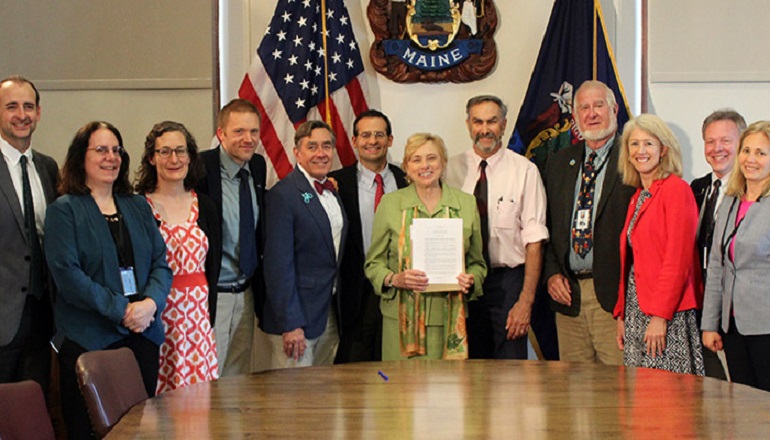
Governor of Maine Janet Mills has signed into law LD 994, legislation that requires the state’s Public Utilities Commission (PUC) to approve the contract for the 12MW Aqua Ventus 1 floating offshore wind project.
Governor Mills said: “With the innovative work being done at University of Maine, our state has the potential to lead the world in floating offshore wind development.
“This long-overdue bill will move us in that direction.”
Aqua Ventus 1 will be the first commercial-scale US floating offshore wind farm.
Senator David Woodsome said: “The University of Maine has become a national leader in research and development around wind power, composite materials, and other important areas.
“The Aqua Ventus programme is one more area where Maine can take the lead in the kind of research that could yield results that impact the world.”
Aqua Ventus 1, supported by $40m (€35m) in grant funds from the US Department of Energy, will deploy turbines on floating structures designed by the University of Maine.
The floating platforms and other components will be assembled in Maine and, once installed, will provide clean energy to Maine and will provide a valuable demonstration for future development in Maine and elsewhere.
Governor Mills also confirmed that the state has accepted an invitation from the Bureau of Ocean Energy Management (BOEM) to participate in a federally-led Gulf of Maine Intergovernmental Regional Task Force on offshore wind with New Hampshire and Massachusetts.
The Task Force, which involves governmental agencies, will seek to identify potential opportunities for renewable energy leasing and development on the Outer Continental Shelf in the Gulf of Maine.
Governor Mills will also direct the creation of the Maine Offshore Wind Initiative, a state-based initiative to identify opportunities for offshore wind development in the Gulf of Maine and to determine how Maine can best position itself to benefit from future offshore wind projects, including opportunities for job creation, supply chain and port development, and offshore wind’s impact on Maine’s energy future.
The initiative will also be tasked with promoting compatibility between potential future uses and existing uses in the Gulf of Maine to inform offshore wind siting considerations and minimise any impact on Maine’s commercial fishing and maritime industries.
Governor Mills said: “Participating in the federal task force will also give Maine a seat at the table to ensure that development moves forward with the least impact to commercial fishing and other ocean-dependent industries.”
While the Maine Offshore Wind Initiative will be led by and include state agencies, it will also solicit the participation of local officials, Maine tribal representatives, marine interests, commercial fishing, energy and environmental organisations, academics, scientists, business and labour.
The initiative will include officials from the Governor’s Energy Office, Office of Policy Innovation and the Future, Department of Economic and Community Development and the state’s natural resource agencies, including the Department of Environmental Protection and the Department of Marine Resources.
The initiative will provide valuable input and inform the state’s participation in the BOEM Task Force.