


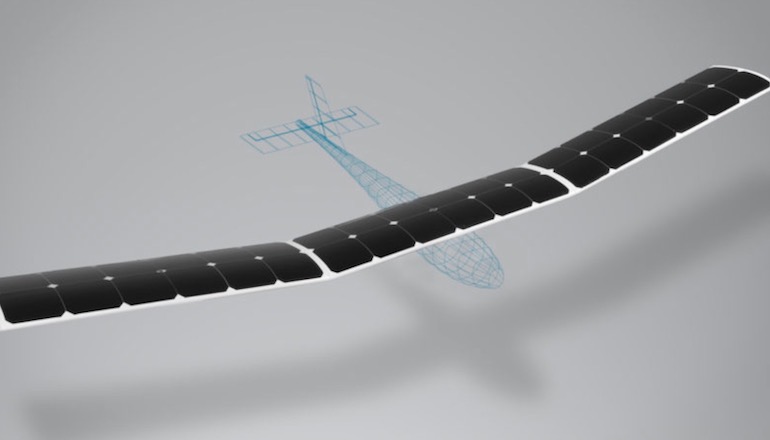
Australian company Praxis Aeronautics is to showcase in the coming weeks an unmanned aerial vehicle or drone powered by solar cells built in the wings.
The UAV will be demonstrated at the Australian International Airshow and Aerospace & Defence Exposition from 26 February to 3 March.
The company said early testing has shown the solar wings can extend drone flying time from three hours to more than nine hours.
Praxis is in discussions with drone manufacturers in the US about forming partnerships to supply the solar wings.
It hopes to have an agreement in place so it can start manufacturing test wings in the coming months ahead of the first commercial sales by the end of the year.
Praxis co-founder and director of innovation and manufacturing Cameron Donaldson said having the solar cells built as part of the wing rather than affixed to it solved power to weight and fragility problems.
Improvements in battery technology would be needed to allow the solar wings to keep a drone in the air around the clock, he added.
“When you get to that whole day of flying stage then the next milestone will be drones that can fly through the night and that requires a huge jump forward in battery tech,” Donaldson said.
The Praxis wings were initially designed using traditional silicon solar cells but wings using lighter, thinner and more efficient gallium arsenide cells were developed in 2018.
The company is now working with four cell manufacturers to provide options at different weights, efficiency and price points for potential partners.
Initial costs range from A$4 a watt at 25% efficiency through to A$400 a watt at 32% efficiency.
“The finish is the same regardless of what kind of cells we use, but the weight is slightly different,” Donaldson said.
“What we’re finding is the cost of (gallium arsenide) cells is prohibitive for a number of the commercial uses but with defence it’s not really cost that’s been holding them back, it’s how rugged you can make them.
“It’s a waterproof product so we’re also talking to companies about putting it on unmanned surface vessels, which are the equivalent of drones for the water.
“We also see applications in things like equipment cases with solar cells embedded for charging hardware like drones when they are being carried around.”