


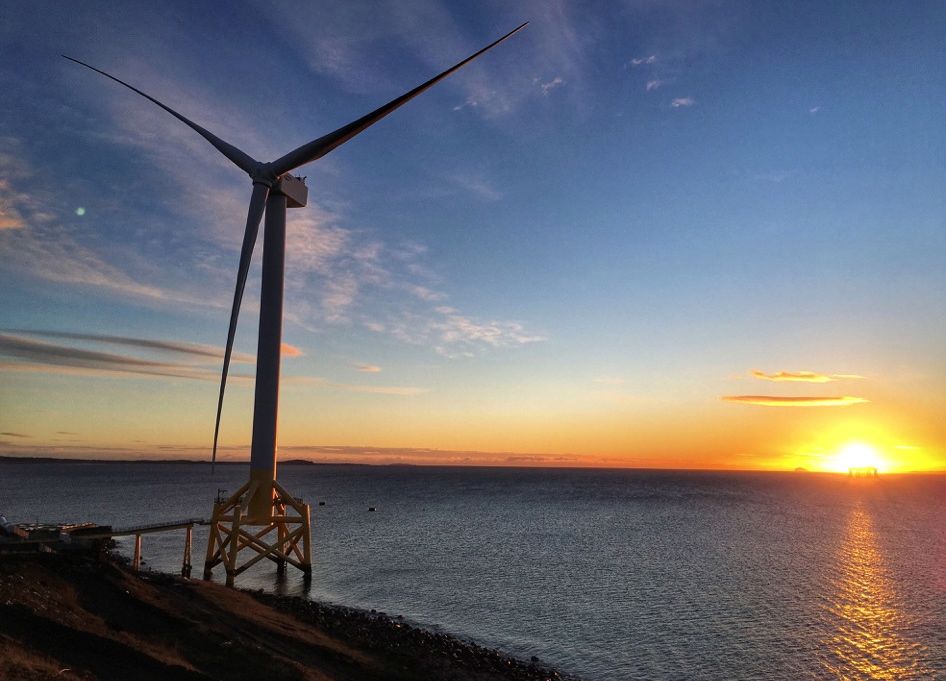
Certification services provider Bureau Veritas and the Offshore Renewable Energy Catapult have agreed to jointly develop a ‘digital twin’ of the 7MW Levenmouth demonstration wind turbine in in Fife in Scotland.
ORE Catapult said it is building on work with several partners to develop a ‘digital twin’ of the turbine, which requires collection of real-time operational SCADA and condition monitoring data from several disparate systems.
Bureau Veritas and ORE Catapult will create of an interactive digital twin, including 2D diagrams and 3D representations of the wind turbine. Post-processed SCADA and condition monitoring data as well as manually collected inspection data will be brought back into a unified database of the turbine.
‘Digital twins’ can improve the operations and maintenance of offshore wind farms by combining real-world turbine operating data with numerical modelling to improve understanding and enable a risk-based approach to O&M, reducing unplanned repairs and interventions, reducing costs, the partners said.
Bureau Veritas global business development manager for marine renewable energy Ian Finch said: “Using Veristar AIM 3D will enable ORE Catapult to benefit from a state of the art asset integrity management system tool where all as-built drawings, operating manuals, and maintenance procedures can be incorporated in the database and updated as needed throughout the life of the turbine.
“Maintenance technicians can have instant access to data about the turbine, including its current condition status, and how to maintain it, directly from the Veristar AIM 3D central database.”
ORE Catapult operational performance director Chris Hill said: “As the offshore wind industry and its asset base matures, the ability for wind farm operators to be able to accurately monitor and predict the future performance and safety of their wind farm assets is critical.
According to Hill the digital twin enables all information on the condition and performance of a turbine fleet, from the initial starting conditions right up to the end of life conditions, to be monitored and recorded.
Hill said: “Having all this information in one central database, together with a full 3D graphical representation of the assets, allows an operator to make critical decisions about how to run the turbine, especially towards the end of its predicted life. It enables a risk-based inspection and reliability-centred approach to maintenance planning and the possibility for future life extension.”
Implementing the Veristar AIM 3D Digital Twin platform for Levenmouth will enable ORE Catapult to develop and share digital twin best practices with the rest of the industry.