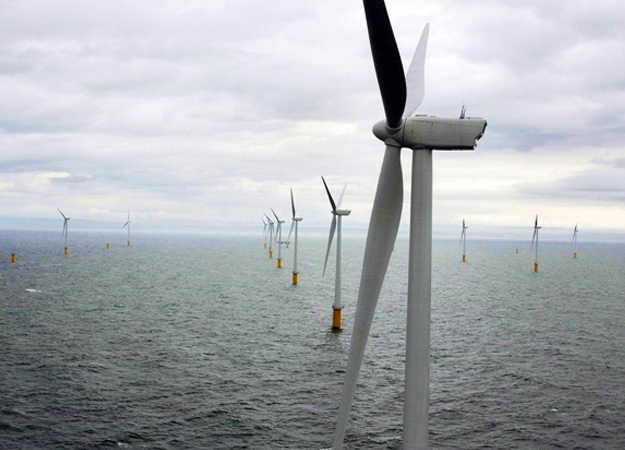
The UK Supreme Court has ruled in favour of utility Eon in the long-running dispute over foundation issues at the 174MW Robin Rigg offshore wind farm between Scotland and England.
Judges said Danish contractor MT Hojgaard was liable for failings that emerged soon after the completion of the wind farm and associated remedial costs of €26.25m
They ruled that problems with the join between the monopiles and transition pieces, which were related to so-called historic grouting issues, were contrary to the original terms of the contract.
“The foundations neither had a lifetime of 20 years, nor was their design fit to ensure one,” said the judges.
The court added: “The technical requirements expressly prescribe only a minimum standard. It was the contractor – ie, MT Hojgaard’s – responsibility to identify areas where the works needed to be designed in a more rigorous way.”
Legal firm Clyde & Co said the judgment “will come as a shock to many”.
Senior associate Mark de la Haye said: “The implications of this judgment include the fact that, in the absence of clear wording to the contrary, contractors may unwittingly be obliged to ensure that their work goes above and beyond current international design standards.”
He warned the decision “will not simply blow over” and has “ramifications beyond the offshore industry”, adding that “going forwards, contractors should be aware of this decision and the increased risk that it potentially entails”.
He added: “This decision could significantly affect the terms of future contracts, the risk assessment of existing contracts, as well as insurance and finance arrangements in the offshore wind farm sector.”
Eon said it was “delighted” by the decision and welcomed the “clarity” provided by the court.
“The ruling shows that MT Hojgaard were obliged to design the grouted connection between the monopile and the transition piece to have at least a 20 year design life,” an Eon spokesperson said.
“The argument that MT Hojgaard had based its design in compliance with a specified international standard J101, which was subsequently discovered to contain an error by a factor of about 10, did not absolve MT Hojgaard from their contractual obligation,” the spokesperson added.
MT Hojgaard has yet to comment on the decision.
The court decided to hear an appeal from Eon in December 2015, despite having previously cleared MT Hojgaard in November that year.
The Danish company set aside Dkr195m (€26m) as a special item in the 2015 accounts to offset potential losses related to the case.
Robin Rigg is one of several wind farms that suffered from the grout issue affecting the join between monopile foundations and transition pieces.
Image: Eon
Eon victorious in Robin Rigg case
UPDATE: Eon 'delighted' by decision in its favour by Supreme Court
 By EBS