DNV GL has certified software being developed by the Offshore Renewable Energy (ORE) Catapult for a new bi-axial blade fatigue testing method.
The methodology – part of a two-year project between the ORE Catapult and Durham University – aims to reduce test times by almost a half and overall test times by a quarter.
It was partly funded by Innovate UK and aims to optimise the design of fatigue tests – which are used to demonstrate that a blade can survive its design lifetime – and enable bi-axial blade testing.
ORE Catapult said the certification paves the way for the next phase of the project, which is to use the software to demonstrate a bi-axial test at full scale at the Catapult’s blade test facility in Blyth, Northumberland.
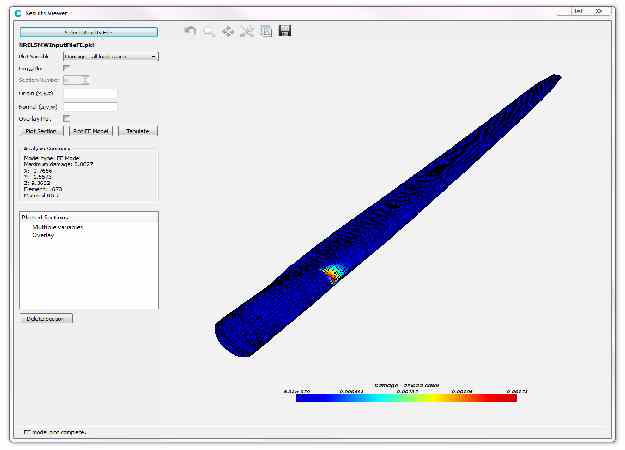
The new process involves blade geometry, materials and loading data being input into the software, which then performs a fatigue analysis on the blade.
The output from this software can then be used to design a fatigue test for the customer.
All the blade testing information is held in a single file.
ORE Catapult research structural engineer – Blades Peter Greaves said: “It’s great that we’re now getting into the final stages of developing this method as an ORE Catapult testing product, and getting the fatigue analysis software certified by DNV GL is a key part of that.
“The bi-axial blade fatigue testing software allows us to gather all of the information that we need in order to design a blade test in a fraction of the time that it currently takes, whilst giving the customer confidence that the results conform to the relevant standards.”
Image: output of blade fatigue analysis software (ORE Catapult)