


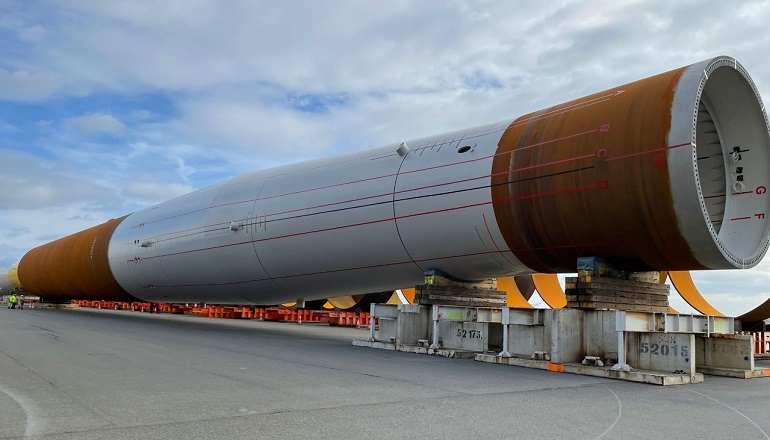
Parkwind’s 257MW Arcadis Ost 1 project will be the first offshore wind farm to make use of a floating vessel to install the project’s turbines in the Baltic Sea.
The new construction approach is the result of a year-long joint development effort between Parkwind, Heerema Marine Contractors and MHI Vestas.
The project, located 20 km northeast of the German island of Rugen, will consist of 27 MHI Vestas V174-9.5MW turbines mounted on monopile foundations and one offshore substation.
Considering the challenging soil conditions at the Arcadis Ost 1 site, Parkwind looked at possible alternatives to traditional installation methodologies, collaborating with Heerema and MHI Vestas to develop the floating installation method.
Parkwind co-chief executive Eric Antoons said: “Taking the turbine installation based on a floating vessel from theory to practice is a major step forward for the offshore wind industry.
“Supported by Heerema Marine Contractors and MHI Vestas, we saw this as the best solution for our German Arcadis Ost 1 project where soil conditions are challenging.”
The installation approach avoids all interaction with the soil thereby reducing the project’s risk compared to a traditional jack-up installation, reducing installation time.
According to the partners, the floating installation method contributes to the further reduction of the levelised cost of offshore wind energy and will “unlock the potential of many offshore areas around the world”.
The developed method is based on using a floating installation vessel to assemble the turbine components.
The vessel hosts all turbine components on its deck as well as a ‘dummy’ tower, which provides a stable platform on board the vessel to assemble the nacelle and the blades.
The first step involves lifting the turbine tower onto the pre-installed turbine foundation. The second step includes lifting the nacelle onto the dummy tower and attaching the blades.
The process ensures “full control” over the blades, thereby guaranteeing a “safe and highly reliable” blade assembly. After the rotor nacelle assembly takes place on the installation vessel, the complete assembly is lifted in one piece onto the turbine tower.
Heerema chief executive Koos-Jan van Brouwershaven said: “More than one year ago, Heerema Marine Contractors, together with our partners MHI Vestas and Parkwind, started an intensive research to find out the possibilities of installing turbines utilising our fleet of floating assets.
“In our simulation centre, we created an authentic visualisation of the local situation, including crane and vessel controls, realistic weather conditions, sea swell patterns and sea bed conditions.
“This collaboration led to an innovative method which will be used for the installation of turbines in the Arcadis Ost 1 wind park. Heerema Marine Contractors is very proud to participate in this unique project. It shows our ambition to remain a frontrunner in the offshore energy market, and our commitment to operate in wind projects all over the world.”