


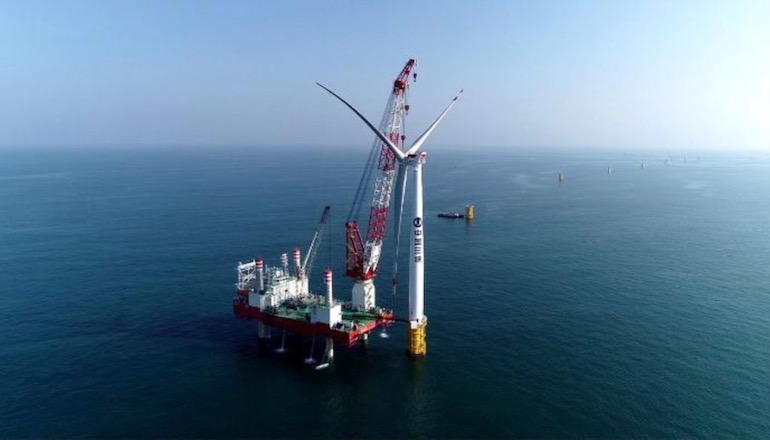
Asia offers the potential for almost 1500GW of offshore wind capacity, according to research by Wood Mackenzie.
The analysis said the bulk of the capacity would be in China, Japan, Taiwan, South Korea and Vietnam.
“As power markets are slowly liberalised across Northeast Asia, there is growing commercial demand for renewables as costs continue to decline and governments seek to attract investment,” Wood Mackenzie said.
However, currently only 0.4% of the total offshore wind potential is operational, it said.
By 2030, the percentage will rise to 5%, with new annual offshore growth in Asia doubling from 4GW a year to over 9GW a year, it added.
China is Asia’s largest offshore wind market today and has the strongest pipeline of future projects, the research found.
Wood Mackenzie said it expects 38GW of new capacity to come online in China by 2029.
But, it said, challenges still need to be overcome.
“The government plans to remove current subsidies by the end of 2021, slowing the rate of growth over the next five years while costs remain relatively high,” the analyst said.
In the short term, there will be record new offshore installations of up to 5GW as developers race to complete projects before feed-in tariffs expire next year.
Thereafter the pace of growth is likely to slow as China offshore wind needs up to $32 a megawatt-hour of subsidy to support new capacity additions from 2022 to 2025.
Falling costs should see wind competing without subsidy by 2028, Wood Mackenzie said.
In the rest of Asia, excluding China, future growth targets aim to add a further 54GW by 2030.
But Wood Mackenzie questioned whether or not their is enough government support in place to achieve this level of development.
“Supportive policy has been critical to Europe’s burgeoning offshore wind sector as governments incentivised offshore investment beginning more than a decade ago,” it said.