


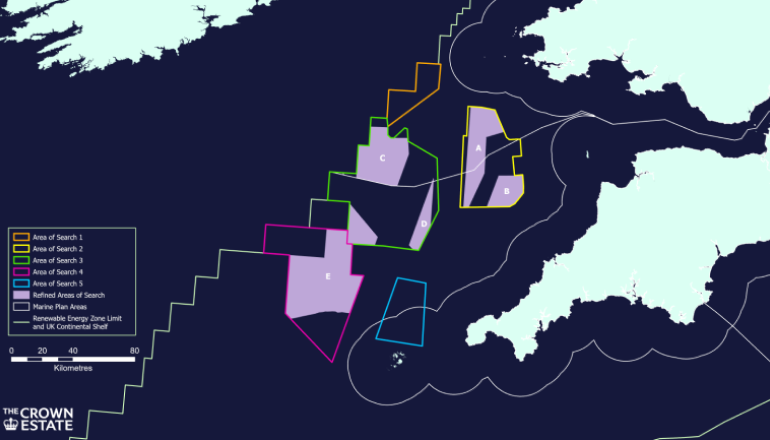
Ahead of this year’s Celtic Sea seabed auction, industry leaders in Cornwall are calling for power lines from floating wind farms to be landed directly in the county.
The Crown Estate’s auction, planned for later this summer, aims to unlock 4GW of electricity by 2035, enough for three million homes, with potential for 24GW in the years following.
Industry leaders in Cornwall are urging both The Crown Estate and the National Grid to bring at least 2GW ashore in Cornwall by 2030 as part of the first phase of Celtic Sea development.
This would unlock industries vital to the UK’s transition to net zero, they say.
This includes mining for minerals like lithium, tin and tungsten which the Government has identified as “critical” to safeguarding British industries now and in the future.
These minerals are found in abundance in Cornwall and large parts of the UK economy depend on them, from electric vehicles to medical and defence equipment.
But Cornwall’s existing electricity network is so constrained that it is holding back the development and growth of these industries, and the ability to “plug” more green energy generation into the National Grid.
An estimated 80% of potential renewables projects in Cornwall are having to wait until 2036 for a grid connection because of capacity constraints, according to the leaders.
There are serious concerns that Cornwall could miss out if power from the first Celtic Sea turbines all lands in Wales or other parts of the South West.
Mark Duddridge, chair of the Cornwall & Isles of Scilly Local Enterprise Partnership, said: “If you think of the National Grid like your ring main at home, it basically ends in mid-Cornwall.
“This lack of capacity is holding back industries old and new, threatening to stifle jobs and investment, which is why we need urgent action.
“A direct 2GW connection from the first phase of the Celtic Sea would literally energise our economy and unlock industries that can play a vital role in the UK’s energy transition, creating thousands of jobs.
“This includes mining critical minerals like lithium and tin, geothermal energy and methane capture, all of which are being pioneered in Cornwall.
“It will decarbonise existing industries by providing an abundance of clean, green electricity and more capacity for local green energy generation.
“That’s why it’s vital the electricity generated from floating wind makes landfall in Cornwall before the end of this decade, and those decisions are being made now.”
Bringing energy ashore in Cornwall from the Celtic Sea would strengthen the National Grid down to its most westerly point (at Indian Queens), the leaders argue, and catalyse investment in the wider transmission network, bringing benefits to the entire South West region.
The North Cornwall coast has been identified as the most suitable location for a cable to make land, they added.
A new electricity sub-station on Cornwall Council owned land could connect to the National Grid at Indian Queens just a few miles away.
Cornwall Council announced this month that almost £1m has been awarded to Falmouth Docks & Engineering Company, operated by A&P Group, from the Government’s Shared Prosperity Fund for an environmental impact assessment to inform potential redevelopment at the port to support the floating wind sector in the Celtic Sea.
Discussions with The Crown Estate and National Grid are due to take place shortly.