


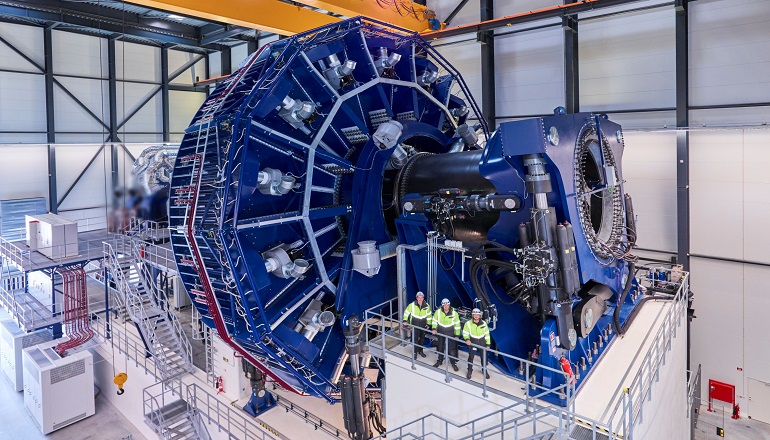
Engineering specialist R&D Test Systems has delivered the largest highly accelerated lifetime testing (HALT) test bench for turbine nacelles at the Lindo Offshore Renewables Centre (LORC) in Denmark.
The new HALT XL test rig can accommodate the next generation of larger wind turbines and prove they are capable of operating reliably in extreme offshore conditions.
HALT XL is mounted on a 30-metre-long concrete base and features a 25MW drive motor that is 15 metres in diameter and the system can deliver a tilt moment of 85 million Nm.
This allows the test bench to simulate the harshest of wind conditions.
Exposing prototype wind turbines to pre-defined HALT tests allows manufacturers to make accurate assessments of reliability and can significantly shorten time to market.
“We needed to design a test bench that could expose wind turbine prototypes to the equivalent of 20 years of weather conditions in just six to eight months,” said Sascha Heinecke, sales director, R&D Test Systems.
“Fundamentally, our job is to stress the prototypes as much as possible, for example, the HALT XL can simulate a dynamic bending moment of 85 MNm – that is equivalent to the pulling power of 67 family cars dangling from the end of a turbine blade 100 metres long,” said Torben Lorentzen, CEO, LORC.
Heinecke added: “Field testing of wind turbines, especially those for offshore use, is becoming more difficult, but HALT testing allows manufacturers to ensure their prototypes conform to applicable standards. It also provides them with a crucial insight into how their new technology will react to the conditions they will encounter out at sea.”
The HALT XL test bench at LORC uses a stepped stress-testing approach that exposes prototype products to diverse accelerated stresses to discover the physical limitations of a design and ascertain product reliability.
The prototypes can be exposed to all the stresses and strains they could reasonably be expected to endure during a 20-year lifetime in just 3% of that time.
During the process, any weaknesses and failure mechanisms can be determined.