


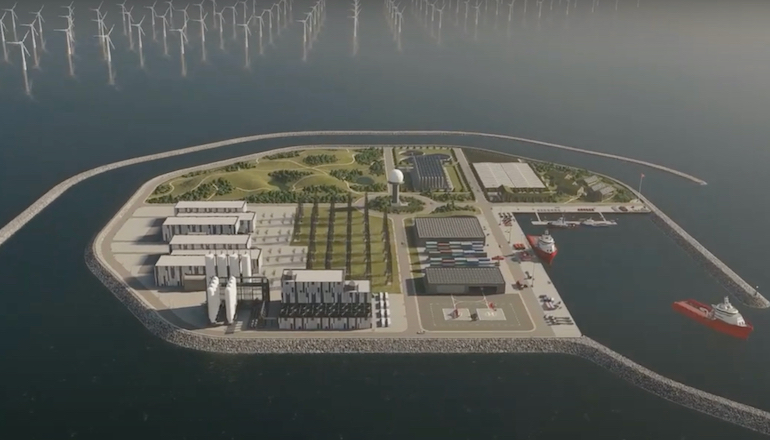
Denmark has reached a landmark agreement on the construction of an energy hub in the North Sea, which will further integrate European grids and accommodate more offshore wind planned in nearby waters.
The energy hub will be an artificially constructed island located 80 km from the shore of the peninsula Jutland and will be developed via public-private partnership model, with the Danish state owning the majority of the island.
Details about the ownership of the island will be made specific in order for a tender for private partnerships, the Danish Ministry for Climate, Energy and Utilities said.
The energy hub, which will be the largest construction project in Danish history, will make a “big contribution to the realisation of the enormous potential for European offshore wind”, said climate minister Dan Jorgensen.
The energy hub will function as an offshore power plant gathering and distributing green electricity from hundreds of wind turbines surrounding the island and transporting the power to consumers in countries surrounding the North Sea.
The island is expected to have a total area of at least 120,000 square meters.
The first phase will be able to provide three million European households with green energy.
Jorgensen said: “This is truly a great moment for Denmark and for the global green transition.
“This decision marks the start of a new era of sustainable energy production in Denmark and the world and it links very ambitious climate goals with growth and green jobs.
“We are at the dawn of a new era for energy. Last year, Denmark set a cut-off date for fossil fuel extraction. Today we are taking a decisive step toward a clean energy future.”
The construction of an artificial island will enable future expansion, for example by building a harbour and facilities for storage and conversion of green electricity from nearby offshore wind turbines to liquid green fuel.
The artificial energy island is in addition to a plan to build another energy hub on the Danish island Bornholm.
The two hubs initial capacity will be 5GW, triple the current installed offshore capacity in Denmark.
Later they will be expanded to provide a capacity of 12GW in total.
Around 200 wind turbines are expected in the first phase of the project.