


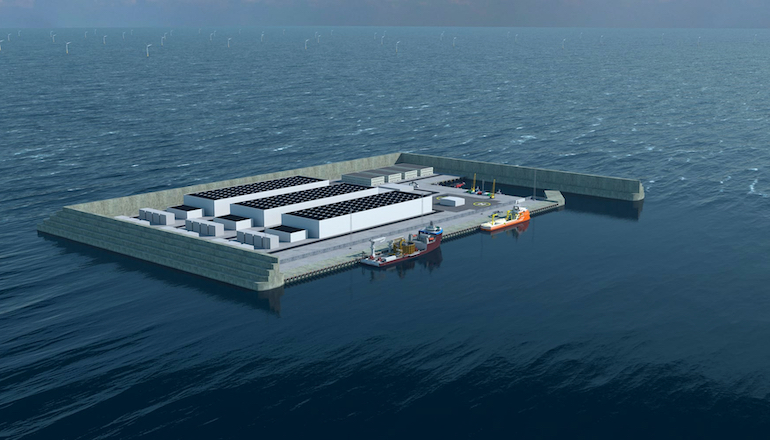
Transmission system operators (TSOs) 50Hertz and Energinet have welcomed the intergovernmental agreement on the German-Danish Bornholm Energy Island project.
The agreement was publicly confirmed by Robert Habeck, Minister for Economic Affairs and Climate Action, and Lars Aagaard, Minister for Climate, Energy and Utilities, at the EU Energy Ministers’ Meeting in Luxembourg.
The intergovernmental agreement creates the conditions for 50Hertz and Energinet to join forces and share their responsibilities fairly to realise the innovative electricity hub on the Baltic Sea island as well as several hundred kilometres of 525kV direct current submarine and land cables.
At least 3GW of offshore wind power capacity is to be made available to the energy markets of both countries via Bornholm Energy Island in the future.
Stefan Kapferer, CEO of 50Hertzm said: “Bornholm Energy Island paves the way to a future in which offshore wind energy is no longer used exclusively by individual countries via point-to-point connections.
“In the future, part of the offshore electricity production will be able to flow via direct current grids at sea to where there is greatest need.
“And in the case of the Bornholm Energy Island project, the lines will also be available for electricity trading between the two countries.
“This makes economic sense, and we are also increasing security of supply under the new geopolitical conditions.”
Thoma Egebo, CEO of Energinet, added: “For Denmark and Energinet, the construction of large offshore wind farms and interconnectors is an important part of the political ambitions and plans to export not only ‘green’ electricity, but also ‘green’ molecules via a future hydrogen backbone in Denmark. Last but not least, this will also support the decarbonisation of German industry.
“This joint project in the Baltic Sea and our projects in the North Sea will therefore have a huge impact on the energy transition in the EU.”
With Bornholm Energy Island, 50Hertz and Energinet are not only doing pioneering work from a technical point of view.
The agreement stipulates that both grid operators will each contribute 50% of the investment in the project and that half of the electricity generated will each be counted towards the European renewable energy targets.
50Hertz and Energinet will also share the congestion revenues from the respective lines to Germany and Denmark in equal shares.