


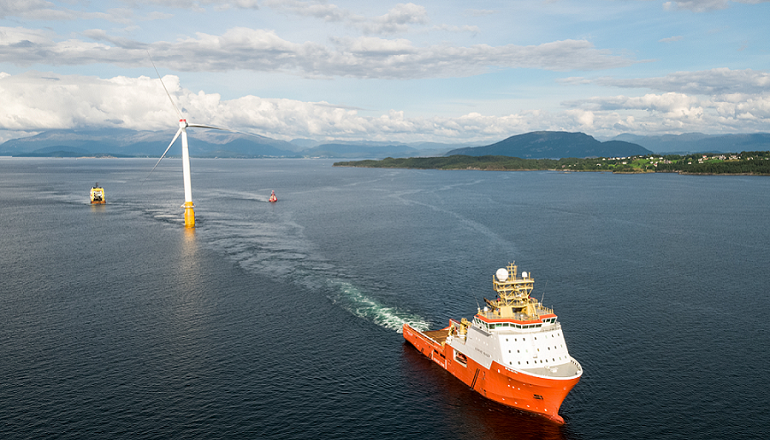
The Crown Estate has awarded seabed rights to Equinor and the Gwynt Glas joint venture between EDF Renewables UK and ESB to develop two 1500MW floating wind farms in the Celtic Sea.
The winners were selected following the conclusion of Round 5 of the UK’s offshore wind leasing programme, which is the first to target floating technology at commercial scale.
Each bidder will pay an annual option fee of £350 per megawatt, or £525,000 per year in total.
A third 1.5GW project development area remains in reserve, with The Crown Estate expected to announce further details by September. If developed, the full 4.5GW capacity could power more than four million homes.
Energy secretary Ed Miliband hailed the outcome as “transformative for economic growth in Wales and the South West,” adding: “The Celtic Sea has huge untapped potential to support our mission to become a clean energy superpower, so we can get energy bills down for good through our Plan for Change.”
Floating wind allows turbines to be deployed in deeper waters beyond the reach of traditional fixed-bottom foundations, unlocking new regions like the Celtic Sea for clean energy generation.
Trine Borum Bojsen, senior vice president for renewables Europe at Equinor, said the leasing “offers the scalability and timing flexibility we seek” and reaffirmed the company’s long-term commitment to the UK market.
Gwynt Glas, a 50:50 venture between EDF and Irish utility ESB, secured the second lease. EDF Renewables UK chief executive Matthieu Hue said the win reinforced the UK’s leadership in floating wind and showed the technology’s critical role in the path to net zero.
ESB’s executive director Jim Dollard called the Celtic Sea “of strategic importance” to the Irish utility, enabling it to scale up floating wind capacity on both sides of the Irish Sea.
As part of their bids, developers pledged to deliver economic and social value alongside generation.
Port Talbot and the Port of Bristol have been named as likely hubs for final turbine assembly.
Both projects will aim for a workforce in which 3.5% are apprentices and at least 10% of those aged 19–24 were previously not in employment, education or training.
The auction followed extensive pre-development work by The Crown Estate, including environmental assessments, stakeholder engagement and a grid connection agreement with National Energy System Operator NESO.
Crown Estate chief executive Dan Labbad said the outcome reflected “how far we’ve come” in the 25 years since UK offshore wind began.
Agreements for lease are expected this autumn, enabling Equinor and Gwynt Glas to begin formal development and consent processes.
Both projects could contribute first power before the end of the decade, helping to deliver up to 10GW of floating wind capacity from the Celtic Sea by 2030 as envisaged by The Crown Estate.
With global competition intensifying for floating wind investment, the outcome of Round 5 is being seen as a strong signal that the UK remains a leading destination for innovation, industrial growth and climate action.