


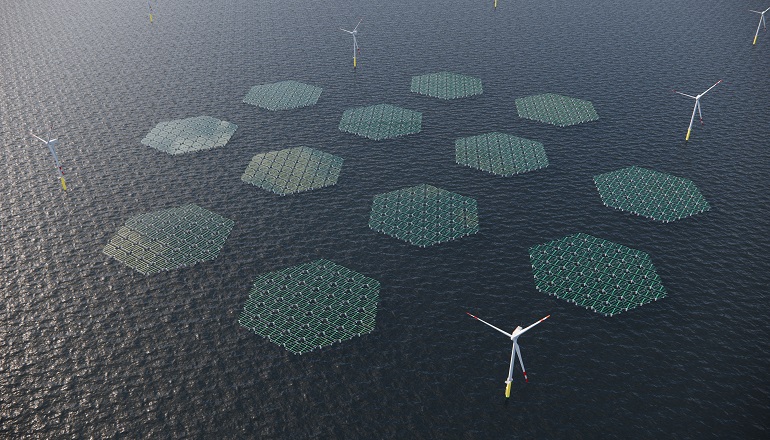
A floating offshore solar project could be built by the end of the decade and be part of a huge ramp-up in the technology in the coming years.
Francesco Melandri, energy engineer at Agnes, told the Seanergy conference that the Agnes Romagna 1 project off the coast of Lido di Classe in the Emilia Romagna region is on target to be built in 2030.
It consists of a 200MW offshore wind farm and a 100MW floating solar power plant.
No technology for the floater has yet been chosen and negotiations with the Italian government on the feed-in-tariff still need to be concluded.
“We will work with the government to create a framework [of support] as it is not economically sustainable at the moment,” he said.
“Our goal is to increase the tariff.”
However, Melandri is hopeful that the benefits of the project will enable it to be installed on a commercial scale.
“Solar farms as part of offshore wind projects can be a hybrid solution,” he said.
“During the summer solar power can be produced when wind speeds are lower. Some studies have reported that putting solar in an offshore wind farm can cut curtailment by 2%.”
Despite the Italian project, Melandri said that it was the Netherlands and the North Sea in general where floating solar is expected to grow at the fastest rate.
Aurélien Croq, chief executive of floating solar technology firm SolarinBlue, agreed that the North Sea was pushing the sector towards development but also hailed Italy and Malta for looking at providing feed-in-tariffs for the technology.
SolarinBlue has the Sun’Sète project which inaugurated on March 17, 2023 is the first offshore photovoltaic farm in France and the Mediterranean.
It has two floating units with a total capacity of 20 kWp. Croq said it has 6% better production compared to rooftop photovoltaics.
It is now developing the Mega Sète pre-commercial demonstrator which aims to develop and deploy a 1 Megawatt-peak (MWp). It is expected to be commissioned later this year.
Croq said the technology was at the start of its journey but that it now needs to “push harder and go for bigger projects.”
He called on more incentives from national authorities to help it “scale up faster.”