


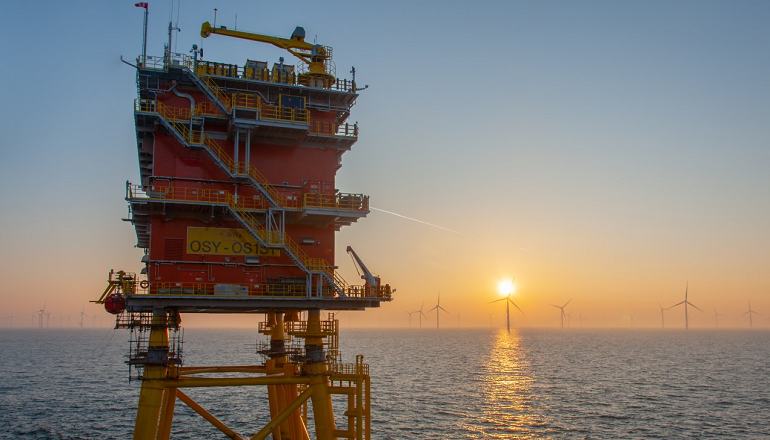
Europe’s grid operators have published their Offshore Network Development Plans (ONDPs) that could help to accelerate the expansion of offshore wind.
The ONDPs, published by the Transmission System Operators for Electricity (ENTSO-E), are the first comprehensive cross-border review of existing offshore grid capacity and future offshore grid requirements at sea basin level.
As well as help to accelerate the expansion of offshore wind the plans will facilitate the deployment of innovative grid solutions to integrate offshore wind power into Europe’s energy system.
WindEurope CEO Giles Dickson and WindEurope Vice-Chair Alfredo Parres attended the launch of the ONDPs.
The ONDPs come on the back of the EU Commission’s EU Grid Action Plan with 14 immediate measures to modernise Europe’s electricity grid and to prepare for the renewables-based electrification of the EU energy system.
The ONDPs translate the EU Offshore Renewable Energy Strategy and the national commitments at the Marienbourg and Ostend Summits into offshore transmission equipment needs and related costs.
The plans give visibility to offshore wind developers, investors and the grid equipment supply chain on what offshore grids to expect for each European sea basin by 2030, 2040 and 2050.
Offshore renewables will become the third-most important energy source in the European power system.
The EU has just under 20GW of offshore wind and by 2050 it wants at least 300GW.
The ONDPs even see 384GW offshore renewables potential in the EU by 2050 and 496GW in all of Europe.
To ensure the most efficient grid buildout possible, future grid connections should be designed at sea basin level rather than at national level.
ENTSO-E presents five different ONDPs, one each for the North Seas, the Baltic Sea, the Atlantic Basin, the West Mediterranean and the East Mediterranean and Black Sea.
Dickson said: “The ONDPs are a significant step forward.
“They’ll help people decide how best to build out offshore grids – cost-effective and environmentally friendly.
They identify existing grid bottlenecks and how to tackle them.
“They also inform the evolution of hybrid offshore wind farms, energy islands and other innovative ways of integrating offshore wind power into Europe’s energy system.”
The ONDPs see significant potential for hybrid offshore wind farms, with connections to two or more countries.
According to the ONDPs 14% of all offshore renewables could be connected as hybrids.