


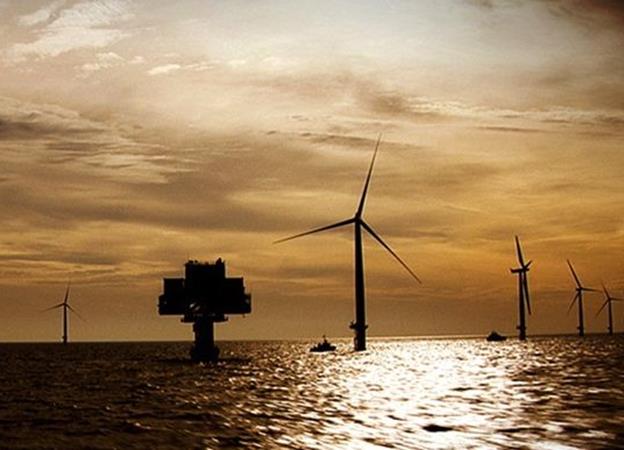
Belgian grid operator Elia Group and Danish wind giant Orsted have unveiled a joint paper which aims to help Europe overcome the barriers impeding the development of ‘hybrid projects’ and deliver integrated offshore transmission projects.
The study’s launch at the WindEurope 2024 conference in Bilbao was attended by Belgian Minister of Energy Tinne Van der Straeten, Danish Minister for Climate, Energy and Utilities Lars Aagaard and Director General for Energy at the EU Commission Ditte Juul Jørgensen.
The paper proposes novel approaches to offshore development, including the adoption of regional planning at sea basin level – e.g. the North Sea or the Baltic Sea – and the establishment of Offshore Investment Banks for Europe’s sea basins.
Elia Group and Orsted said they want to help Europe to harness the full renewables potential of its seas and more effectively distribute the green electricity produced among its countries.
Offshore hybrids are a crucial element for securing Europe’s green transition said the partners, they added. This has been confirmed in ENTSO-E studies which outline that up to 80GW of offshore wind capacity could be connected to two or more markets by 2050. Yet, to date, only one such project (the Kriegers Flak – Combined Grid Solution, which connects Denmark to Germany) has been realised.
Elia and Orsted said this is primarily due to the regulatory framework in place, which has traditionally supported the development of either generators or interconnectors, rather than encouraging assets that include both – which hybrid projects do. Moreover, existing planning strategies tend to prioritise individual national interests, meaning that cross-border and regional solutions are sidelined, they added.
Since purely national solutions will not be enough to ensure the success of the energy transition, Elia Group and Orsted’s paper aims to disrupt the status quo.
Indeed, offshore wind potential is not spread out equally across Europe. Some countries have a shortage of renewable energy sources – like Belgium and Germany – while others, like Denmark, have more renewable energy than they can use domestically.
Hybrid interconnectors would help Europe harness the full renewables potential of its seas while more effectively distributing the green electricity produced among different countries.
“There is an increasing recognition across Europe that it will be very challenging to meet the targets that we’ve set out for ourselves as a society,” said Orsted Europe chief executive Olivia Breese.
“Creative solutions such as those we are proposing are needed to address the unique challenges of the energy transition in a cost-effective way.
“When time is of the essence, you need everyone at the table.”
The first solution involves regional planning at sea basin level that prioritises projects with the highest potential in terms of generating socioeconomic welfare and reaching net zero.
This regional planning should be accompanied by regional Offshore Investment Banks that would aim to allocate existing funding streams for each sea basin area in a more efficient manner to maximise impact, with private investors invited to contribute.
To make sure the financial risks and benefits of hybrid projects are allocated in a fair way, a review of the framework for hybrid interconnectors is needed, with a specific focus on the fair distribution of risks and benefits among TSOs, wind farm developers and society at large.
Two alternative approaches are proposed in the paper: firstly, capacity based two-sided contracts for difference; and secondly, a ‘Commercial +’ approach, focused on enabling power purchase agreements for offshore wind farms connected to two or more markets.
Finally, the paper states countries and the EU should encourage the development of more hybrid projects from which we can learn to expand the use of hybrid solutions on a larger scale. We must start delivering tangible projects as soon as possible so that we can speed up the learning loops – commercial, technical and regulatory – and deliver more and better projects on an accelerated timeline, it added.
“We are launching our vision paper at a crucial moment,” said Elia Group’s interim chief executive Catherine Vandenborre.
“The climate agenda is increasingly becoming an investment agenda so that Europe can reduce its dependence on fossil fuels and retain industry. We are facing European elections and new legislative initiatives will further the implementation of the Green Deal.
“Our proposals aim to encourage new ways of thinking and discussions between all stakeholders so that we can help Europe harness the full renewable potential of its seas while more effectively distributing the green electricity produced among its countries.”