


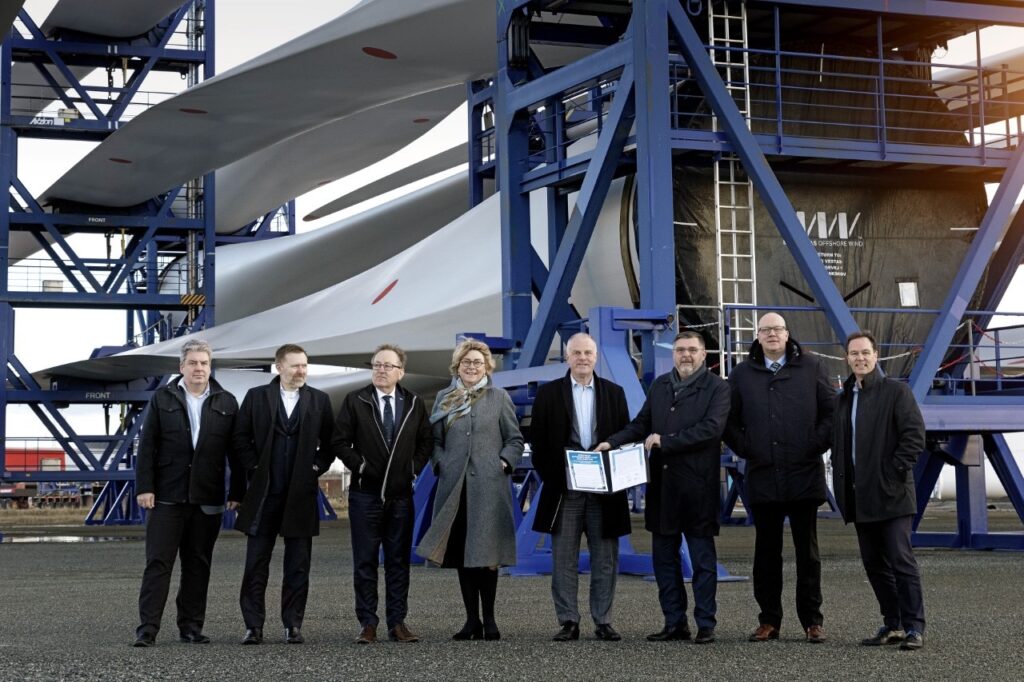
Representatives of the six largest offshore wind ports in Europe have signed a declaration at Port Esbjerg in Denmark to join forces in order to meet Europe’s deployment targets for the energy source.
The European offshore wind strategy target is to deploy at least 65GW of offshore wind by 2030, something the ports say they don’t currently have the capacity to make happen.
The six ports are Port Oostende in Belgium, Groningen Seaports/Eemshaven in the Netherlands, Niedersachsen Ports/Cuxhaven in Germany, Nantes-Saint Nazaire Port in France, Humber in the UK and Port Esbjerg in Denmark.
Together they will try to change that with the the first discussions and sharing of experiences taking place at the Danish port.
The aim is to collaborate at an operational and practical level.
The declaration states: “We, Europe’s leading offshore ports, will be crucial to accomplish this massive expansion of European offshore wind capacity.
“We are fully committed and stand ready to do our part of the work.
“By strengthening cooperation between the ports, operationally and practically, we can lay the groundwork that will lead to future extensions and sufficient capacity.”
The ports also want to send a signal to the market that they are willing to do anything to accelerate the green transition with offshore wind.
Back in May, the Esbjerg Declaration dramatically increased the target for offshore wind in Europe.
Germany, Denmark, Belgium, and the Netherlands have set a combined target to deliver at least 65GW of offshore wind by 2030.
Port Esbjerg chief executive Dennis Jul Pedersen said: “Today, the six of us as signed a declaration stating that we will do everything we can to support Europe’s ambitious aims.
“In May, the politicians set the framework with the original declaration, and today we’ve started to act on the challenge they gave us all by raising sky-high the targets for offshore wind.”
The ports may, for example, collaborate on getting around the issue of space shortages.
If one facility only has space for half a project, another one may have space for the other half.
The ports will also try to ensure optimal processes and, for example, share digital experiences.
Port Esbjerg has just developed a digital tool –a so-called digital twin – to help triple the capacity of offshore wind in the future, without having to expand.
The collaboration should also support political work in Europe.
Secretary general in the European Sea Ports Organization (ESPO) Isabelle Ryckbost said: “The importance of ports in Europe should not solely be calculated in tonnes, but should also be assessed in terms of their contribution in the deployment and supply of energy, in particular renewable energy.
“I am very excited to see these six important wind energy ports joining their efforts and leading the way in view of reaching the EU offshore goals.
“Through cooperation it will be easier to face the identified headwinds.”