


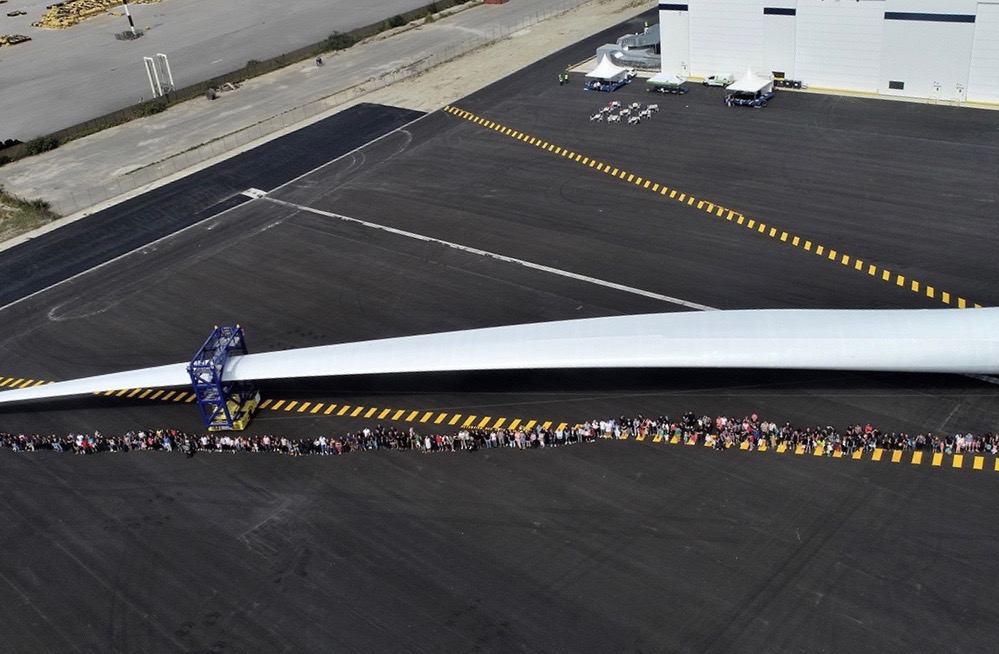
A cross-sector consortium, including LM Wind Power and Engie, have announced plans to design and manufacture the first 100% recyclable turbine blade.
With a product lifespan of 30 years, wind turbines currently have a recyclability rate of 85% to 90%.
The ZEBRA (Zero wastE Blade ReseArch) project will work together for 42 months with a budget of €18.5m.
Driven by French research centre IRT Jules Verne, aims to demonstrate on a full scale the technical, economic and environmental relevance of thermoplastic wind turbine blades, with an eco-design approach to facilitate recycling.
The strategic consortium represents the full value chain: from development of materials, to blade manufacturing, to wind turbine operation and decommissioning, and finally recycling of the decommissioned blade material.
LM Wind Power will design the product, process and manufacture two prototype blades using Arkema’s Elium resin, in order to test and validate the behavior of the composite material and its feasibility for industrial production.
In parallel, the ZEBRA project partners will focus on developing and optimizing the manufacturing process by using automation, to reduce energy consumption and waste from production.
Project partners will then explore methods to recycle the materials used in the prototype blades into new products.
Finally, a life cycle analysis will assess the environmental and economic viability of further utilizing the thermoplastic material in future wind turbine blades.
ZEBRA project Manager at IRT Jules Verne Céline Largeau said: “Demonstrating a circular approach to wind turbine blades throughout their lifetime requires mobilising a strategic consortium covering the whole value chain to guarantee valuable and precise industrial data and achievements.
“The ZEBRA project is a great opportunity to join together Arkema, CANOE, ENGIE, LM Wind Power, Owens Corning and Suez who are key leaders in the wind energy sector.
“We look forward to carrying out constructive work altogether to improve wind energy performance and efficiency.”