


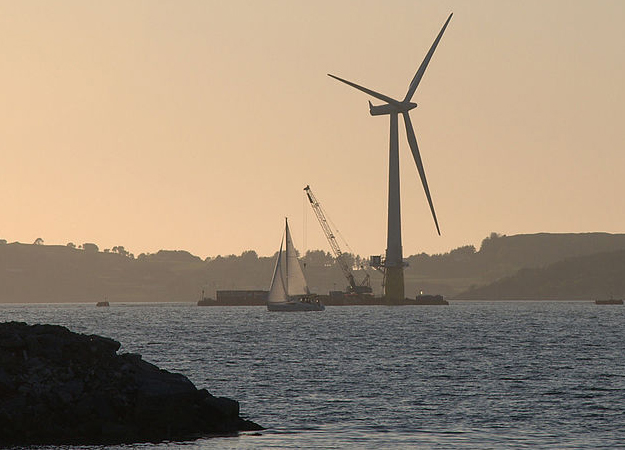
Exploiting floating wind opportunities will help to bring down the cost of producing green hydrogen, says a new study from German consultancy Roland Berger.
Floating wind, which allows wind to be harnessed along deeper coasts represents a “huge untapped opportunity in places like Europe, the United States and Japan” where large offshore wind resources are located in waters too deep for fixed seabed foundations.
Floating offshore wind could even be combined with hydrogen conversion to enable green hydrogen production in remote waters known for strong and consistent winds, the study, titled “Innovate and industrialize – How Europe’s offshore wind sector can maintain market leadership and meet the continent’s energy goals” highlighted.
Roland Berger senior associate Maarten de Vries said: “It is conceivable that floating turbines, green hydrogen and the use of floating production, storage and offloading vessels (FPSO) will come together to enable offshore production of very low-cost green hydrogen – no matter how remote the location.
“Off the southern coast of Greenland, for example, where so-called katabatic winds generate wind energy capture that is 3.5 times higher than in the North Sea.”
“Innovate and industrialize – How Europe’s offshore wind sector can maintain market leadership and meet the continent’s energy goals” sets out how offshore hydrogen, floating technology and further cost reductions will let European offshore wind players “continue to lead the way”.
“It is better to convert offshore wind energy into hydrogen through electrolysis at the source at sea, rather than on shore” said Bram Albers, principal at Roland Berger’s Amsterdam office.
At higher volumes it is cheaper to transport energy in molecular form through a pipeline than as electrons through a cable. The energy could also be stored as hydrogen in salt caverns and depleted gas fields, the study found.
A single pipeline can land as much energy as 10 power lines or more, avoiding “time-consuming consultations” for additional cable landings in vulnerable coastal areas.
The rollout of offshore wind can be “even cheaper and faster by repurposing existing infrastructure and pipelines”, the study stated.
Hydrogen produced from offshore wind is relatively expensive and about two-thirds of the cost per kilogram is attributable to offshore wind energy itself.
The study stated that if European players act now to realize offshore hydrogen, floating technology and further cost reductions, they can fend off the competition and continue to lead the industry while building a future “above and beyond carbon for the citizens and economies of Europe – and the world”.