


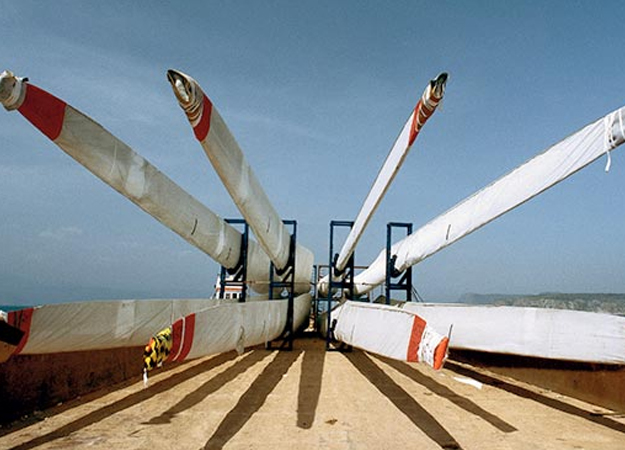
The Fraunhofer Institute for Wind Energy Systems (IWES) is developing comprehensive concepts aimed at making it possible to recycle and reuse rotor blades considerably better in the future.
Working in collaboration with the Institute for Energy, Recycling and Environmental Protection (IEkrW) at Bremen University of Applied Sciences, the aim is to set up an economically feasible disposal strategy allowing as high a recycling quota as possible.
The Concept for recycling and reuse of rotor blades made of plastic composite materials (KoReNaRo) project has received €150,000 from the German Federal Ministry of Education and Research’s (BMBF) Research for Sustainable Development – FONA3 programme.
The funding is currently for the conceptual design of a demonstration system.
A decision will then be taken on whether implementation should be funded in a second phase.
The scientists are aiming to develop a higher-quality recycling system for the entire EOL rotor blade.
The important aspect is first of all to design an automated initial treatment for this, whereby the rotor blade can be more effectively dismantled and separated into its individual components, Fraunhofer IWES said.
This creates recycling loops, increases the recycling rate, and saves costs. One possible location for a recycling station would be Bremerhaven.
Bremerhaven business development company BIS managing director Nils Schnorrenberger said: “Bremerhaven wants to establish itself as a location for the disposal or recycling of wind turbines at an early stage.
“A study was recently commissioned in which the market segment was examined in greater detail and an initial logistics and disposal concept for onshore and offshore wind turbines was drawn up in order to be able to approach potentially interested companies with it.”
Another goal of the research project is to reuse the spar caps – which give the rotor blade its stability – from the rotor blades for other workpieces, preserving the existing good material characteristics as far as possible.
That represents a challenge, as they are made up of centimetre-thick layers of glass fiber and carbon fibre composites.
The approach of recovering the high-quality glass fibres from the thick-walled flange and cap materials by means of slow-batch pyrolysis is also to be pursued further.
The synthesis gases generated in this process can then be further utilized, among other things for energy or hydrogen production.
The cost-efficiency and feasibility of this special process should be verified in the project using a test system.
For the sandwich components in the rotor blade, balsa wood and plastic foams, already known methods are to be rolled out on a large scale, in particular for recycling the balsa wood as wood foam.
Project coordinator Steffen Czichon said: “Holistic conceptualization is important to create a sustainable recycling concept for rotor blades that gives the wind industry a clear framework to create a competitive market for secondary products and disposal.
“For this, we need concrete implementation strategies.
“In the KoReNaRo research project, we at Fraunhofer IWES contribute our comprehensive competencies in component and material testing as well as our many years of experience in rotor blade development and manufacturing.”