


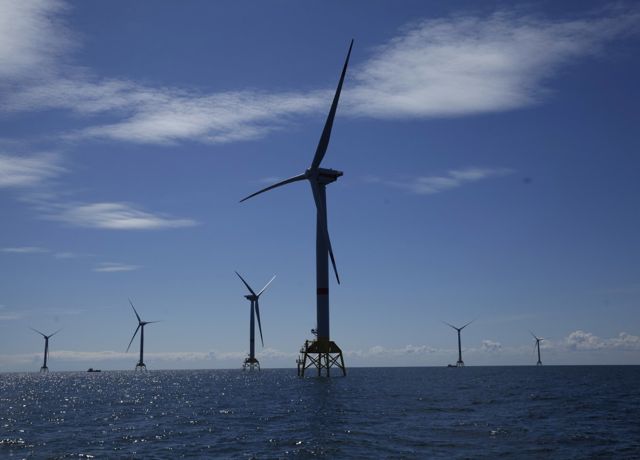
Germany could miss its 2030 renewables goal if the country does not increase its offshore wind target to 25GW from 20GW currently, according to research by German think-tank Agora Energiewende.
The think-tank also said in the ‘The green electricity gap, its effects and how it can be plugged’ report that annual solar expansion must also be doubled to 10GW or onshore wind expansion must start to grow again to 4GW a year.
Currently Germany is on track to deliver a 55% share of renewables by 2030, instead of the 65% target, Agora Energiewende said.
“If all of this fails, higher wholesale electricity prices can be expected, Germany would be increasingly dependent on electricity from abroad and CO2 emissions in the electricity sector would increase by 5 to 20 million tonnes per year,” it added.
Agora Energiewende director Patrick Graichen said: “The crisis in wind power is now entering its third year. This already makes it a real challenge to achieve the renewable energy targets for 2030.
“This means that electricity prices and climate protection targets are under pressure.
“To change this, the federal government and the federal states must now take rapid and decisive measures to expand renewable energies.
“That means we need enough space for the construction of wind turbines, faster planning and approval procedures, a solar offensive and ambitious planning for the expansion of offshore wind energy.
“The longer politicians hesitate about the energy transition, the bigger the green electricity gap and the more fatal the consequences will be.”
The study assesses five scenarios in which the addition of solar, on- and offshore wind varies.
One scenario assumes that onshore installation doubles from last year to 2GW by 2023 and offshore wind grows in line with government goals to 20GW by 2030, while 4GW a year of new solar comes online.
In this scenario, renewable energy will only account for 55% of the electricity mix by 2030, said Agora Energiewende.
The think-tank bases its analysis on gross electricity consumption of 600 terawatt-hours, about 20TWh more than the government has previously planned for.
This is because the authors assume a slight increase in electricity consumption from electric cars and new heat pumps.
Another scenario called ‘Focus on solar’ sees photovoltaic expansion grow to 10GW a year by 2023 and then remain at this level until 2030.
At the same time, 25GW of offshore wind wind is built at sea instead of the 20GW currently envisaged, while onshore wind grows to 2GW a year by 2023.
In the ‘Focus wind’ scenario, onshore wind growth increases to 3.5GW by 2022 and 5.1GW by 2030, offshore wind delivers 25GW and solar 4GW a year to 2030.
Both scenarios would achieve the 65% renewables goal, the study said.
Two other scenarios – ‘Sector coupling: focus on wind’ and ‘Sector coupling: focus on solar’ – are also considered if gross electricity consumption rose to 650TWh.
They assume that a switch from industrial processes to climate-friendly technologies will increase the demand for electricity.
In the ‘Sector coupling: focus on wind’ scenario, onshore wind grows to 3.5GW by 2023 and 6.3GW by 2030, solar to 6GW by 2022 and offshore wind to 28GW by 2030.
‘Sector coupling: focus on solar’ sees an additional 10GW of PV power from 2023.
The expansion of onshore wind will initially increase to 3.5GW a year by 2022, and will continue to grow to 5.1GW per year by 2030, while offshore wind is assumed to be 25GW by 2030.
In these sector coupling scenarios, the 65% target is achieved despite the higher electricity consumption, the CO2 emissions of the electricity sector are 5 to 15 million tonnes lower than those of the trend scenario, said Agora Energiewende.