


Global cumulative offshore wind installations, excluding China, will exceed 520GW by 2040, according to Rystad Energy.
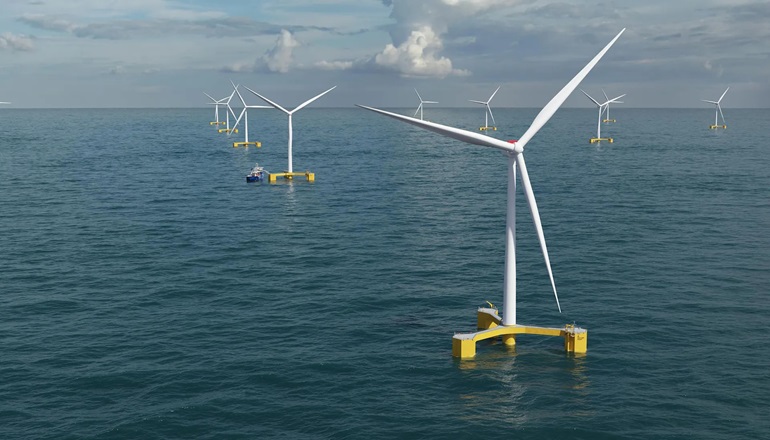
Europe will play a crucial role in this growth, relying heavily on floating wind to meet national targets and is expected to account for more than 70% of global floating wind installations by 2040.
Though some project delays beyond 2030 are anticipated, there will likely be a strong push to accelerate deployment with floating wind capacity projected to approach 90GW by 2040.
The UK, France and Portugal will be at the forefront of the floating wind push.
Asia will also be key in advancing floating wind as a mature technology, and the region – excluding mainland China – is expected to capture a share of 20% of global installations by 2040.
While the floating wind sector has seen a recent rise in project announcements, it currently grapples with supply chain constraints similar to the bottom-fixed segment, where wind turbines are installed on fixed foundations in shallow waters.
These challenges could hinder the advancement of floating wind technology in the short term, according to Rystad, with capacity estimates of less than 7GW by 2030.
“The global offshore wind sector is experiencing robust growth, fueled by increased investment and auction activity.
“However, supply chain bottlenecks present significant challenges to the industry’s further expansion.
“While ambitious targets boost investor confidence, it is crucial to address logistical issues to ensure that offshore wind can successfully take a key role in the energy transition.
“This will not only help the technology mature, but also foster a supportive ecosystem that inspires investor reliance,” said Petra Manuel, Senior Analyst, Offshore Wind at Rystad Energy.
In the bottom-fixed market, Rystad expects the UK, Germany and the Netherlands to emerge as the three dominant players.
The countries’ proximity to the North Sea and extensive maritime areas provides a strong foundation for success in offshore wind, bolstered by their installation and net zero targets.
Together, these three countries are projected to account for a total of 150GW of installed capacity by 2040, followed by the US with less than 40GW.
The future of the US market is contingent on its political landscape.
Rystad Energy’s long-term forecast for the floating wind sector differs significantly from the upward trend observed in the bottom-fixed market.
From 2025 to 2030, Rystad anticipates that only Asia and Europe will be actively installing floating wind capacity.
By 2030, it expects Europe to have installed almost 5GW of floating wind, while Asia, excluding mainland China, is projected to add 2GW.