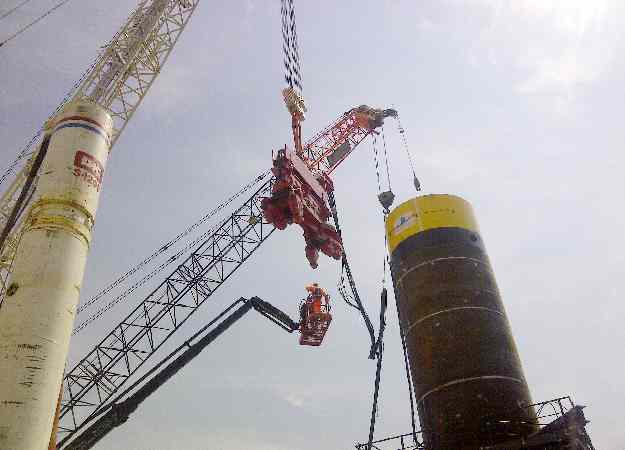
A Carbon Trust Offshore Wind Accelerator-led programme has devised a methodology to pre-determine the load-bearing capacity of vibrated piles as part of a project to test alternative ways of installing offshore foundations.
The test involved a comparison of the conventional method of impact hammering with the vibration of steel piles on land.
It aimed to prove whether vibratory piling can offer a faster and more environmentally friendly method of installing steel foundations for offshore wind farms and to evaluate the method with regard to stability.
The tests on land highlighted that the vibratory method generates lower peak noise emissions and is up to 10 times faster.
However, continuously present noise emissions will need to be determined on a project specific basis, but will have an impact on the environment under water.
The lateral bearing capacity of large diameter piles has been measured allowing an initial methodology for the prediction of vibrated pile bearing capacity to be developed.
The project participants are RWE Innogy, Bilfinger Offshore, DONG Energy, EnBW, E.ON and Vattenfall.
RWE Innogy said it now plans to build on these tests and launch an additional subproject intended to investigate ways of optimising the installation methodology itself.
Carbon Trust director of innovation Jan Matthiesen said: “Finding innovative methods to reduce the cost of installation will help to bring down the cost of offshore wind, making it competitive with conventional energy sources.
“The project results not only demonstrate that vibro techniques could be a viable method for piling, but also evidence of what can be achieved through industry collaboration.”
Image: vibratory piling test (RWE)