


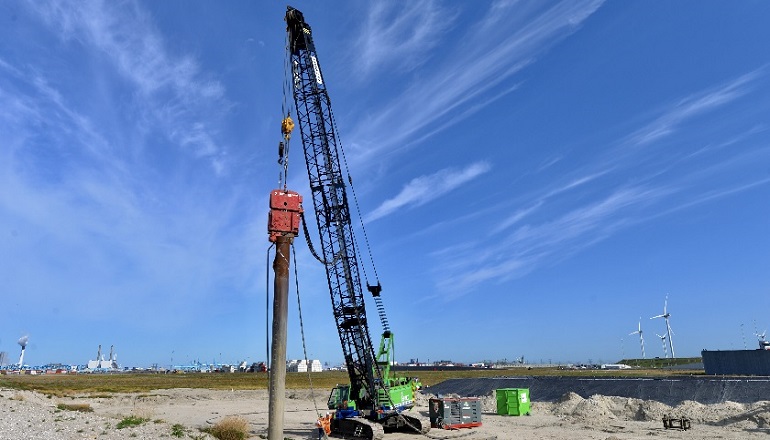
Dutch outfit GBM Works has developed a new method it claims can reduce noise caused by driving offshore wind turbine foundation piles into the seabed by 90-95%.
This method involves fluidising the seabed with water jets, which ensures the monopiles sink more quickly, and with “significantly less” noise, under their own weight.
To assess this new system at a site in Maasvlakte, tests were carried out to measure the monopiles’ vibrations and deformations using strain gauges, supplied by HBK.
GBM Works founder Ben Arntz said: “Driving foundation piles for wind turbines into the seabed causes vibrations, pressure waves and – in particular – also a great deal of noise.
“When a steel foundation pile with a diameter of eight metres is driven, the noise production can reach a level up to 180 decibels.
“The vibrations, the pressure waves and the loud noise have a negative effect on underwater life. Therefore regulations have been adopted to reduce the noise production of piledriving activities at sea. International guidelines are expected to become stricter in the coming years. Our new method responds to this.”
GBM Works’ approach involves dozens of water jets spraying seawater into the seabed inside the pile.
As a result, the seabed takes on properties comparable to those of quicksand. The resistance of the seabed decreases and the foundation pile sinks into the seabed.
The second part of the solution comprise a vibratory hammer that replaces the hydraulic piledriving rig that causes the monopile to vibrate so that it sinks into the fluidised seabed layer.”
To assess the operation of the system and demonstrate the added value of the new method in practice, a series of tests was conducted at the Maasvlakte in September 2020.
The 62 test installations were executed with four setups: two with the jet gun system and the vibratory hammer and two tests with the vibratory hammer alone on the same foundation piles.
Wouter Verschueren, a data and model engineer at GBM Works, said: “We saw, for example, that the foundation piles with the vibratory hammer alone penetrated the ground no farther than three or four metres because the soil resistance became too high.
“With the jet gun and the vibratory hammer, the piles easily went to a depth of 10 metres, while the speed at constant force quadrupled.
“In a subsequent test cycle underwater the noise production of the solution with the vibratory hammer and the jet gun will be compared to that of a traditional pile hammer.
A piledriving rig in combination with a sound mitigation system is currently used.
“These are complex systems that operate with an underwater shield around the foundation pile to damp the vibrations and noise. GBM Works expects a noise reduction of 90 to 95 percent thanks to the new system,” Verschueren added.