


Netherlands-based contractor LiftOff has unveiled its Major Component Exchange Vessel (MCEV) at the RenewableUK Global Offshore Wind exhibition in London.
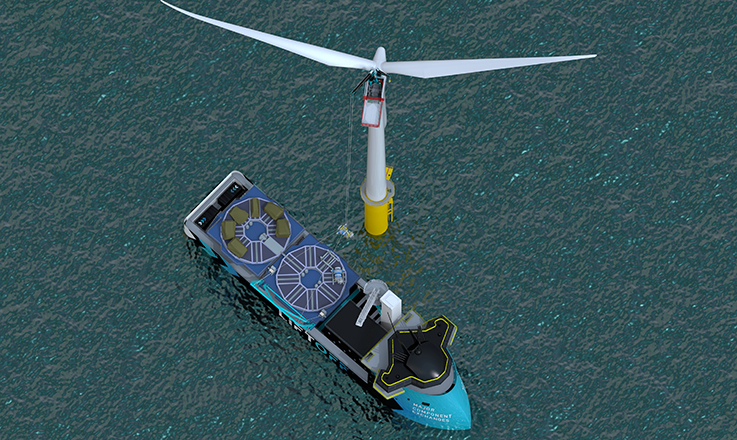
Designed to meet rising demand for offshore wind turbine maintenance, the MCEV (pictured) combines LiftOff’s up-tower crane technology with capabilities of modern offshore dynamically positioned (DP) vessels and mission equipment.
LiftOff will offer turnkey services for major component exchanges using the MCEV.
With a rapidly expanding offshore wind energy market, combined with an ageing fleet of installed wind turbines, operators face increasing delays due to limited jack-up and heavy-lift vessel availability.
This drives up costs and increases turbine downtime, threatening levelised cost of electricity (LCOE) competitiveness.
LiftOff says its MCEV is a purpose-built vessel designed to transport multiple generators and gearboxes, making it ideal for both large-scale and smaller Major Component Exchange (MCE) projects.
The company claims the MCEV significantly shortens response times and enhances the efficiency of MCE operations.
“With this new vessel, LiftOff is changing the game in the MCE market,” said Eelko May, managing director of LiftOff. “The MCEV allows us to scale our services and better support wind farm owners, operators and turbine OEMS across the globe.”
Based on a conventional DP2 vessel, the MCEV features a custom up-tower crane with nacelle-mounted winches, enhancing safety by removing direct load connections to the vessel.
The aft deck is equipped with a motion-compensated platform that carries cargo comprised of both crane equipment and wind turbine major components, while a motion-compensated walk-to-work system ensures safe and efficient crew and small component transfers.
Unlike jack-up vessels, the MCEV does not require seabed contact, eliminating the need for pre-arrival site characterisation.
LiftOff says the MCEV’s DP2 dynamic positioning system ensures precise station-keeping, even in challenging sea conditions, while the vessel also enables faster transit between turbines and sites.