


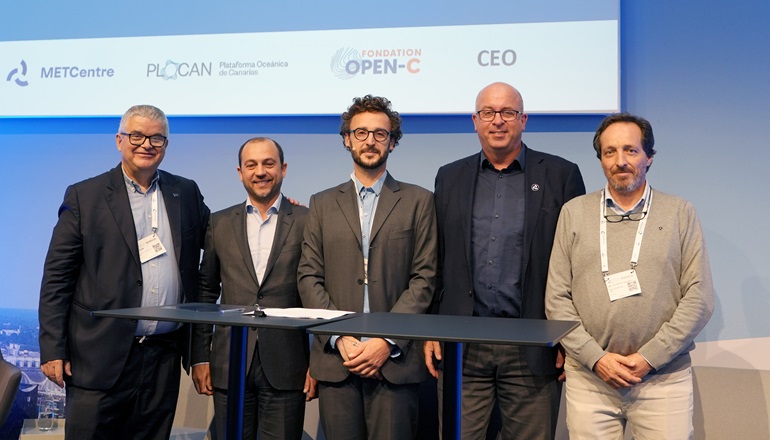
At WindEnergy Hamburg five European offshore wind test sites formed a new alliance, aiming to improve conditions for floating wind demonstration projects.
BiMEP, Companhia de Energia Oceanica (CEO), Fondation OPEN-C, METCentre and Plataforma Oceanica de Canarias (PLOCAN) have created HiPoTeSis.
This “unique and collaborative network” of operational offshore demonstration test sites, in countries including Spain, Portugal and Norway, aims to provide the European Union with the future “high-power infrastructure” for testing new floating wind projects.
In a seminar hosted by World Forum for Offshore Wind at WindEnergy Hamburg the test sites presented their action points (image of representatives of the test sites).
These include implementing fast track permitting system for demo projects, inclusions of two annual demo projects in relevant EU calls, creating a new European support scheme for co-investments in infrastructure and initiating better incentives for data sharing.
“Testing and demonstration projects are absolutely necessary to bring costs down in floating offshore wind,” said chief executive of Norway’s METCentre Arvid Nesse.
“With a target of 10GW by 2030, it is crucial to standardise and industrialise floating technologies between 2024 and 2030.
“To remain a leader, the EU must develop this infrastructure and act now to stimulate innovation,” said OPEN-C Foundation general manager Bertrand Alessandrini.
In Europe, test sites are subject to the same permitting procedures as commercial parks, which take years to complete.
“Our experience is that the permitting process could be more straightforward, considering these permits are intended for a limited number of turbines, for a limited length of time and already located in testing areas, compared to commercial wind farms,” said president of the Board of Directors at Portugal’s CEO Carlos Pinho.
Establishing grid infrastructure at the test sites to prepare for the next generation of floating offshore wind turbines requires substantial capital investments.
Substations and export cables to shore are examples of infrastructure that need to be in place.
“Our test sites are essential for the acceleration and success of the industry in Europe, and that is a compelling argument for increased funding schemes,” said PLOCAN director Jose Joaquín Hernandez Brito.