


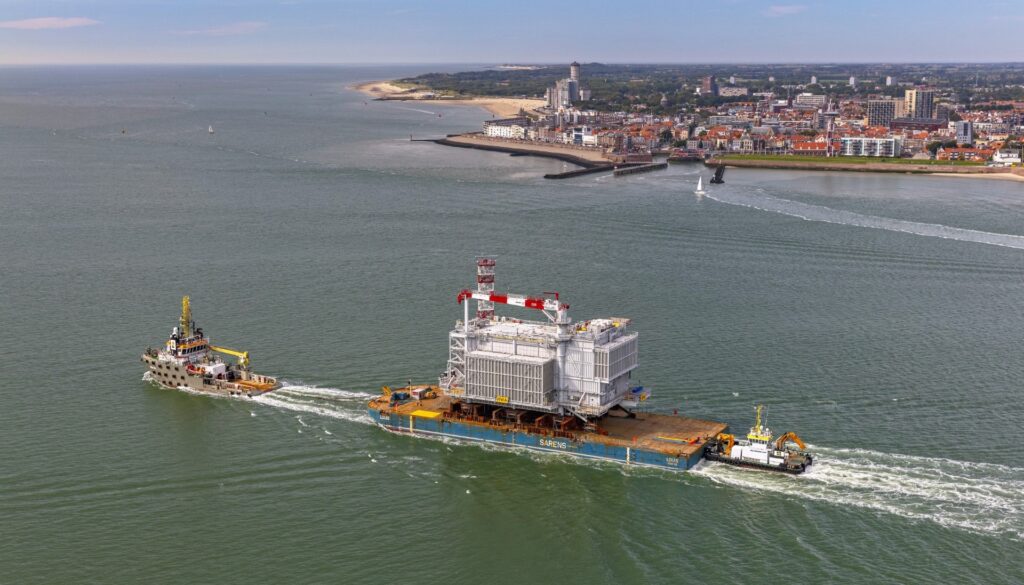
Two weeks after the successful load out, the steel superstructure (topside) for the Hollandse Kust West Beta platform will leave the port of Hoboken near Antwerp on Saturday 17 May in the afternoon.
The transport on a floating pontoon will then sail via the Scheldt and the Western Scheldt towards the North Sea.
Around midnight, the special TenneT transport will sail past Vlissingen on its way to its final destination off the North Holland coast.
As soon as the installation vessel Sleipnir has completed its current job in British waters, this vessel from the fleet of Heerema Marine Contractors will sail to the coast of North Holland.
Next Monday, the superstructure of the transformer platform, weighing over 3,500 tonnes, will be installed 50 kilometres off the coast of Egmond aan Zee.
The undercarriage (jacket) has been firmly anchored to the seabed since May last year.
On site, the large crane on the Sleipnir will lift the 45-metre long, 20-metre wide and 25-metre high structure from the floating pontoon and place it on the undercarriage.
The topside and jacket will then be welded together and connected to the electricity grid in the coming months.
This brings the completion of the third and final 700MW platform, built for TenneT by the Equans/Smulders contractor consortium, into view.
The electricity cables for the “socket” are already ready in the seabed.
As soon as operator RWE has had the wind farm built, the wind turbines will be connected to TenneT’s platform.
The power then comes ashore via the “sea cables” at Velsen and is transported underground to the transformer station in Wijk aan Zee.
From there, the power is fed into the national high-voltage grid at the correct voltage along the A9 at Beverwijk.
With the connection of the “Alpha” and “Beta” plots in the Hollandse Kust (west) wind energy area, the installed capacity on the Dutch North Sea will reach 6.1GW in the coming years.
In the meantime, TenneT is continuing to build on the connections for the new 2GW wind farms via Maasvlakte 2 and Borssele to realise the government’s ambition – 21GW at sea in 2032.