


UK civil engineering and environmental hydraulics outfit HR Wallingford worked with Orsted on the development of stable cable crossings for the latter’s 659MW Walney 3 offshore wind farm in the Irish Sea.
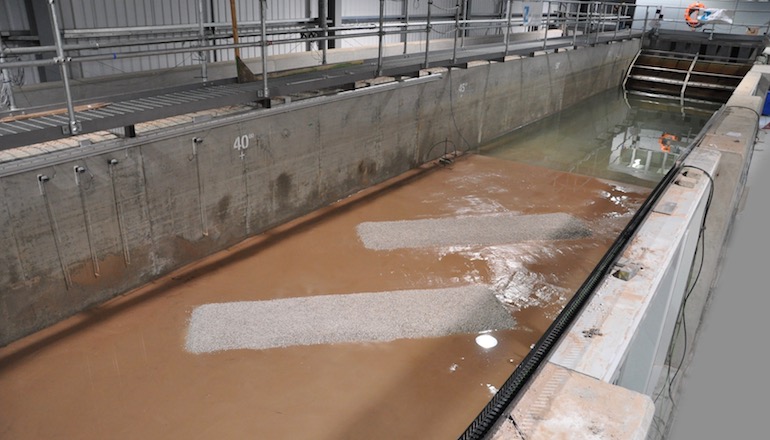
HR Wallingford carried out scour tests at its fast flow facility as part of work to deal with a congested seabed near the project site.
Walney 3’s cables had to be installed at a site that had existing cables and pipelines in place. The wires had to be buried over the existing assets using a cover of rock called ‘rock berm’.
The rock berm can sometimes cause large holes or scour in the seabed that can expose the existing assets and lead to expensive repair bills, HR Wallingford said.
Therefore the tests were carried out to help ensure the design was right from the outset, the company added.
HR Wallingford senior coasts and oceans scientist Kerry Marten said: “Morecambe Bay experiences fast tidal flows and some of the largest tidal ranges in the world, so we needed to be able to see how the rock berms installed near to each other were affected by scour.
“We investigated how the scour patterns developed to see how the orientation of the berms caused more or less of an obstacle to the tidal flows, and whether this increased or minimised the scour effects.
“We used this, and further physical modelling tests, to produce engineering guidelines in partnership with Orsted to inform the design of their eight cable crossing rock berms for Walney extension.”
Orsted lead scour engineer Andreas Roulund said: “The rock berms were installed in late 2017. We were pleased to see that no scour was observed in the post-installation surveys, which has, in the short term at least, confirmed the effectiveness of the new design guidelines in minimising the risk of scour.”
The research involving this work will be presented in November 2018 in Taiwan at the International Conference of Scour and Erosion.