


Ireland could develop up to 18GW of additional fixed-bottom offshore wind on top of current plans, according to a new government assessment.
The Offshore Wind Technical Resource Assessment, released by the Department of Environment, Climate and Communications, outlines the country’s long-term offshore wind potential and recommends prioritising fixed over floating technology in the near term.
It finds that between 3.5GW and 18GW of new fixed-bottom capacity could be reasonably developed around the Irish coast, beyond the 8GW already planned through Phase One projects and the South Coast Designated Maritime Area Plan.
The assessment also examines floating offshore wind, concluding that while Ireland has strong long-term potential, fixed-bottom wind remains more cost-effective at all viable locations today. Floating development is expected to become more competitive as global technology matures.
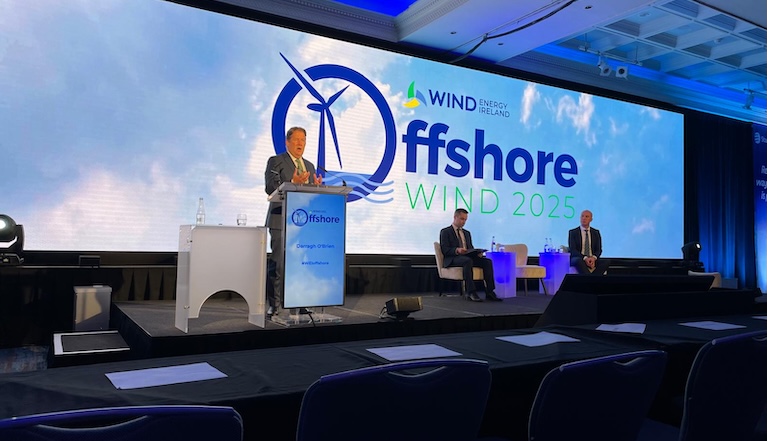
Climate and energy minister Darragh O’Brien, who spoke at Wind Energy Ireland Offshore Wind 2025 today in Dublin (pictured), said: “The Offshore Wind Technical Resource Assessment is an important initial step as we look to designate offshore wind sites along our coastline.”
The report will inform the next stage of site designation, including a full marine spatial planning process and the development of Ireland’s National Designated Maritime Area Plan for Offshore Renewable Energy.
The study was released alongside the government’s Future Framework 2025 Review, which confirms a 20GW national offshore wind target by 2040 and highlights progress on the country’s long-term renewable energy strategy.