


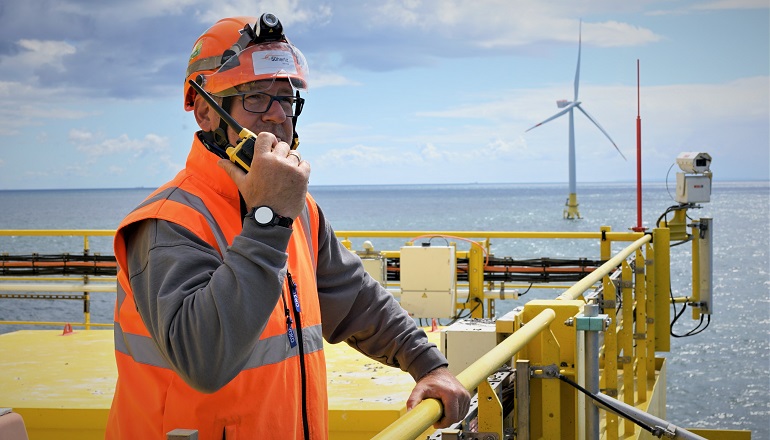
The EU Competition Authority has exempted Energinet’s and 50 Hertz’s Krieger’s Flak Combined Grid Solution (CGS) project from rules that at least 70% of the capacity of external connections must be made available to the electricity market.
In the Krieger’s Flak CGS project Denmark and Germany will link three offshore wind farms with a new electricity link between the two countries.
The exception for the project applies for 10 years with the possibility of a 15-year extension.
Energinet Electricity System Responsibility CEO Soren Dupont Kristensen said: “It is very positive that the EU has understood that Krieger’s Flak Combined Grid Solution is a unique project that operates under completely different conditions from traditional foreign links.
“We are pleased to have a 10-year exemption with the possibility to apply for 15 more years of additional exemption.
“The rule that 70% of the capacity of an electricity connection must always be available to the electricity market breaks with the design of the ground breaking CGS idea, which combines offshore wind farms with an international connection to create an efficient and cheaper green transition.”
The rule was introduced by ministers from the 27 EU countries, as well as a majority in the European Parliament in 2020, after the CGS solution was conceived, approved and inaugurated.
In addition to being an electricity link between two countries’ electricity systems, the CGS solution connects the upcoming Danish offshore wind farm Kriegers Flak and the two existing German offshore wind farms Baltic 1 and 2 in one common solution that makes the most of the electricity cables.
When the wind blows, power from the wind turbines from the three parks is sent ashore to consumers in either one or both countries, but when the wind does not blow, or when the turbines’ current only fills parts of the cables, the excess capacity is offered in the cables for the electricity market, so that power can flow between the two countries.
The CGS solution, the first of its kind in the world, ensures that the cables are fully utilised more than in traditional offshore wind farms, bringing value for money for bill payers.
50 Hertz CEO Stefan Kapfere said: “The exception is a strong signal from the EU to innovative projects.
“The EU Commission’s decision shows that projects such as KF CGS – which have been planned for more than 10 years and are inaugurated – are possible, even though legislation along the way has changed as a result of the Clean Energy Package with the 70% rule.
“This means that the green power generation from the Kriegers Flak and Baltic 1 and Baltic 2 offshore wind farms can be fully exploited because only the excess capacity has to be made available to the electricity market.
“It is important that the EU now sets a forward-looking and stable set of rules for hybrid interconnector projects, because Kriger’s Flak CGS was probably the world’s first of its kind, but certainly will not be the last.”