


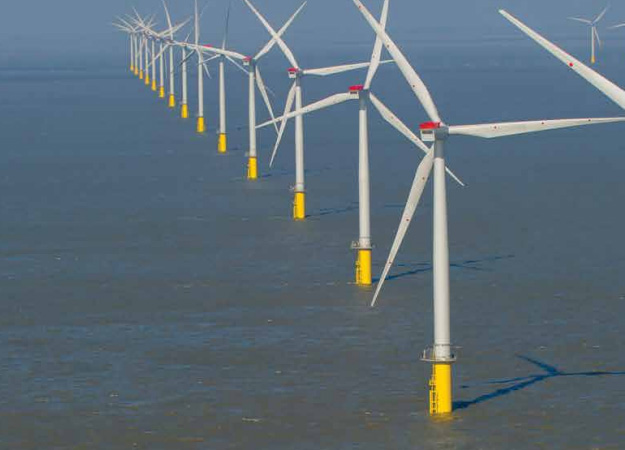
The EU-funded MARINEWIND project has launched an interactive tool to assess the Levelised Cost of Energy (LCOE) for both floating and bottom-fixed offshore wind farms.
Developed under the Horizon Europe programme and co-funded by UKRI, the model was led by the University of York with input from project partners including APRE, Europêche, CNR, Energy Systems Catapult, Q-PLAN International, Ricerca Sul Sistema Energetico, SENER and WavEC Offshore Renewables.
Unlike conventional models that deliver a single cost estimate, the MARINEWIND LCOE Tool simulates real-world variability by accounting for inflation, interest rates, operating costs and wind conditions. It provides a range of outcomes over a project’s lifetime, helping users understand how financial and environmental factors influence offshore wind economics.
“The tool bridges the gap between financial modelling and technological uncertainty,” said Paola Zerilli, MARINEWIND scientific coordinator at the University of York. “By showing realistic ranges instead of fixed numbers, it helps investors, policymakers and researchers make more informed decisions about where and how floating wind can be most cost-effective.”
The model includes adjustable country-specific data such as CAPEX, OPEX, tariffs and production volumes, allowing users to test financing mixes and market conditions. Outputs include evolving metrics such as LCOE, Weighted Average Cost of Capital and Return on Equity.
Designed to support developers, policymakers, financiers and researchers, the tool complements MARINEWIND’s broader work to accelerate floating offshore wind deployment across Europe, alongside its Booklet of Recommendations and WebGIS platform.