


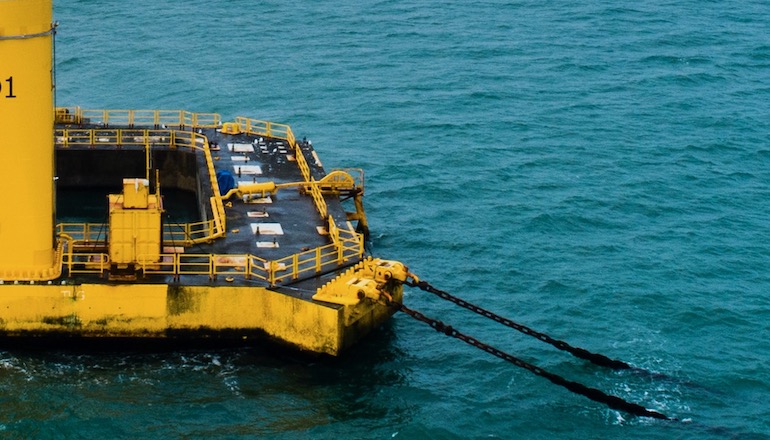
Robust mooring integrity management is essential for securing finance and insurance coverage for floating offshore wind projects, according to a new report from the World Forum Offshore Wind (WFO).
WFO’s ‘White Paper Mooring Systems for Floating Offshore Wind: Integrity Management Concepts, Risks & Mitigation’ report said the integrity management philosophy should cover all stages of the mooring life cycle and be developed in detail during the initial design phase.
It added, however, that there is no ‘one-size-fits-all’ solution to mooring systems for floating offshore wind.
Redundancy is an important issue when considering continuous energy production, the report said.
The provision of alternative load paths through additional lines (n+1 concept) is generally considered the preferred option.
However, increasing the capacity or size of equipment, effective sparing strategies, employing load reduction devices and utilising digital twins to facilitate predictive maintenance may also be suitable approaches to improving availability.
WFO said its committee identified that an independent, anonymised reporting system which benefits all stakeholders deserves further investigation and may therefore form part of its future work.
It added that, while common failure modes and degradation mechanisms are well understood from offshore oil and gas experience, there is limited transferability with respect to floating offshore wind.
“New threats are either unknown or less well-understood and consequently not easily prevented by existing integrity management practices,” WFO said.
It called for all integrity management data and not just failures to be made available so that the whole industry can learn quickly together.
Intellectual property and commercial contractual constraints also need to be relaxed or modified to facilitate data sharing, WFO said.
WFO Moorings Subcommittee chair David Timmington said: “We trust this white paper clearly introduces the main concepts and design choices with respect to moorings for floating offshore wind turbines, identifies key considerations with respect to integrity management practices and points towards future detailed work of WFO’s subcommittee.”
WFO managing director Gunnar Herzig said: “Following the publication of WFO’s two white papers on Insurability and Maintenance for floating offshore wind we are thrilled to present this third paper which will hopefully help the industry to accelerate the global build-out of floating offshore wind.”