


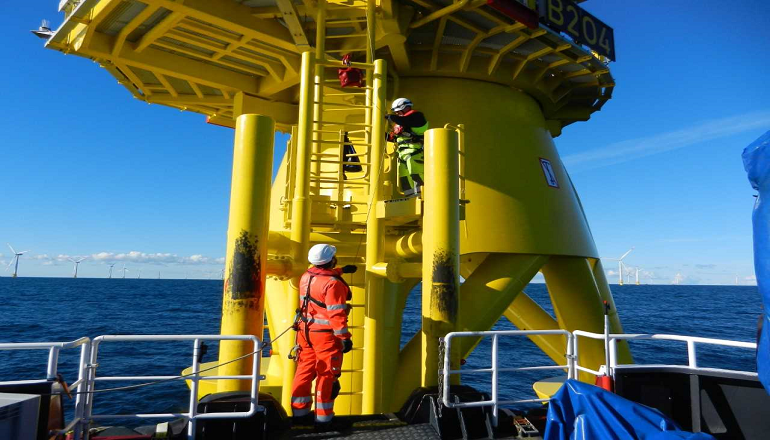
An Offshore Renewable Energy (ORE) Catapult-coordinated project backed by the EU has developed a sail/no sail decision-support tool for marine coordinators to reduce the impact of choppy seas on offshore wind workers.
The two-year DemoWind2-funded Improving the Safety and Productivity of Offshore Wind Technicians in Transit (SPOWTT) project, was coordinated by ORE Catapult through its O&M Centre of Excellence collaboration with the University of Hull.
Work, which was completed in March, involved seven partners, including Siemens Gamesa, marine coordinators SMC, Dutch research institutes MARIN and TNO and data provider BMO Offshore.
The data-driven model seeks to understand the complex relationship between environmental conditions and vessel design and their combined impact on technicians and has given a new understanding of seasickness and how likely it is to develop, the project participants said.
Studies were carried out, both in the field and in controlled conditions, on various vessel types to understand how they behave in different weather conditions.
Empirical data was also gathered directly from the technicians during transit over a period of several months.
TNO used this seasickness model, coupled with vessel behaviour data from MARIN – validated with measurements by BMO – to provide more realistic logistics simulations to assist offshore wind farm planners.
SMC is building on this to commercialise decision-support software aimed at marine coordinators.
ORE Catapult project manager Andrew Stormonth-Darling said: “This project has been ground-breaking. For the first time, we have used data, gathered in laboratories and out in the field, to truly understand the psychological and physiological impacts on offshore wind farm technicians during transit.
“The model and tool will improve the health, safety and wellbeing of technicians and the productivity of offshore wind farms, allowing wind farm marine coordinators to make more informed decisions on vessel design for particular sites and when to authorise transits.”
Siemens Gamesa managing director Clark McFarlane said: “SGRE is proud to have taken part in this important project; the safety and wellbeing of staff has always been at the core of our business.
“For anyone to arrive at their place of work in a safer, healthier and more content manner, while additionally delivering efficiency gains through the clever application of technology, is great for the future of the industry as a whole.
“These studies show an industry working hard together with SGRE playing a vital part.”
University of Hull senior lecturer in psychology and director of the Centre for Human Factors Fiona Earle said: “Looking at the health, wellbeing, safety and productivity of technicians in CTVs is complex, requiring knowledge of human factors, ship motions and the offshore wind domain.
“By collaborating in this multi-discipline team, we have been able to increase our understanding considerably about what sea-sickness is; how it manifests in technicians; the effects it has on wellbeing, fatigue and fitness to work; and the effect of vessel movements, as well as other factors such as the previous night’s sleep.
“As well as useful guidance for operators, and input to the decision-support tool, this study has given a great basis for further study into the causes and effects of technician sea-sickness.”