


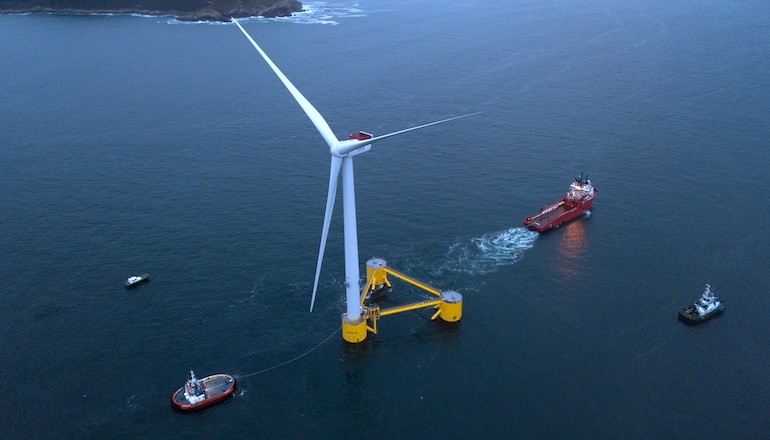
The National Renewable Energy Laboratory (NREL) has been awarded just under $6m in funding for work in the field of floating offshore wind turbines.
The $5.7m, from the Department of Energy’s Advanced Research Projects Agency-Energy (ARPA-E), will support three projects NREL is leading within ARPA-E’s Aerodynamic Turbines Lighter and Afloat with Nautical Technologies and Integrated Servo-control (ATLANTIS) programme.
NREL laboratory programme manager Brian Smith said “Offshore wind market forecasts show accelerated growth.
“These projects ensure that innovative floating offshore wind technologies will continue to develop and expand U.S. offshore wind energy capacity.”
In the first project NREL researchers will develop an open-source software tool, called wind energy with integrated servo-control (WEIS). NREL is partnering with the University of Illinois Urbana-Champaign on this project.
The second project will generate data for floating turbine loads, motion, and performance as part of the Floating Offshore-wind and Controls Advanced Laboratory (FOCAL).
The DoE award will fund the first public floater scale-model dataset to include advanced turbine and hull controls, and hull flexibility.
NREL is partnering with the University of Maine and DNV GL on this project.
In the third project NREL aims to reduce the cost of energy generated by floating wind to below the $0.075 per kilowatt-hour generated by fixed-bottom offshore wind plants.
In the project, dubbed ultraflexible smart floating offshore wind turbine (USFLOWT), NREL is partnering with the Colorado School of Mines, Colorado University at Boulder, University of Virginia, University of Illinois Urbana-Champaign, and the American Bureau of Shipping.
NREL also will be working on other ATLANTIS projects funded at the University of Maine, University of Texas at Dallas, Rutgers University, and the company WS Atkins.
The ATLANTIS programme aims to develop what the DoE describes as “radically new” floating offshore wind turbines by maximising their rotor-area-to-total-weight ratio while maintaining or ideally increasing turbine generation efficiency.
The programme will also build computer tools to facilitate floating turbine design and will collect real data from full and lab-scale experiments to validate the designs and computer tools.