


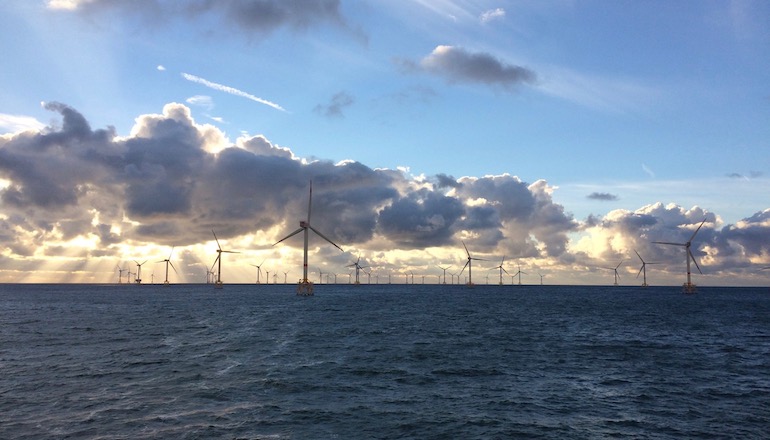
Global offshore wind capacity will reach more than 234GW by 2030, up from just over 29GW at the end of 2019, according to a new report from the Global Wind Energy Council (GWEC).
The increase will be led by exponential growth in the Asia-Pacific region and continued strong growth in Europe, the GWEC ‘Global Offshore Wind Report’ said.
It found that 2019 was a record year for offshore wind, with 6.1GW of new capacity added globally, bringing total global cumulative installations to 29.1GW.
China remains in the number one spot for the second year in a row for new installations, installing 2.4GW, followed by the UK at 1.8GW and Germany at 1.1GW.
Europe continues to be the leading region for offshore wind, but countries in the Asia-Pacific region, such as Taiwan, Vietnam, Japan and South Korea, as well as the US market are quickly picking up the pace and will be regions of significant growth in the next decade, GWEC said.
Over 205GW will be added by 2030, of which at least 6.2GW will be floating offshore wind, the report said.
This represents a 15GW increase from the forecasts in GWEC Market Intelligence’s pre-COVID forecast, “demonstrating the resilience of the sector to play a major role in powering both the energy transition and a green recovery”.
Europe remains the largest market for offshore wind as of the end of 2019, making up 75% of total global installations.
The region will continue to be a leader in offshore wind, with an ambitious 450GW goal by 2050 driven by installations in the UK, Netherlands, France, Germany, Denmark and Poland, with several other EU markets posting double-digit volumes.
North America currently has just 30MW of offshore wind capacity in operation at the end of 2019, but deployment will accelerate in the coming years with 23GW forecasted to be installed by 2030.
In China, 52GW of new offshore wind capacity is expected to be installed by 2030.
Taiwan is set to become the second-largest offshore wind market in Asia after mainland China, with a goal of 5.5GW by 2025 and an additional 10GW by 2035.
Other markets in the region are also beginning to scale-up their offshore wind markets, with Vietnam, Japan and South Korea expected to install 5.2GW, 7.2GW and 12GW of offshore wind capacity respectively.
GWEC chief executive Ben Backwell said: “Offshore wind is truly going global, as governments around the world recognise the role that the technology can play in kickstarting post-COVID economic recovery through large-scale investment, creating jobs and bringing economic development to coastal communities.
“Over the coming decade we will see emerging offshore markets like Japan, Korea and Vietnam move to full deployment, and see the first offshore turbines installed in a number of new countries in Asia, Latin America and Africa.
“The report shows that 900,000 jobs will be created in the offshore sector over the next decade – and this number can only increase if policymakers put in place recovery strategies that can further accelerate growth of the sector.
“Furthermore, 1GW of offshore wind power avoids 3.5 million tonnes of CO2 – making it the most effective available large-scale technology to avoid carbon emissions and displace fossil fuels in many geographies.”
GWEC strategy director Feng Zhao said: “The industry’s outlook has grown more promising as more and more countries around the world are waking up to the immense potential of offshore wind.
“As the market continues to grow, innovations in the sector such as floating offshore wind, larger and more efficient turbines, as well as power-to-X solutions will continue to open new doors and markets for the sector and place the offshore industry in an increasingly important position to drive the global energy transition.
“Offshore wind has already proven itself as an affordable, scalable, zero-carbon technology, and maximising the growth potential of the industry has depended on collaborative action between governments and industry for market design, to set clear capacity targets, undertake forward-looking planning for infrastructure development and workforce requirements.
“There are plenty of lessons we can take from the last 30 years of offshore wind development in Europe to ensure the long-term success and growth of the industry in new markets around the globe, as we are only beginning to unlock the full clean energy potential of offshore wind.”