


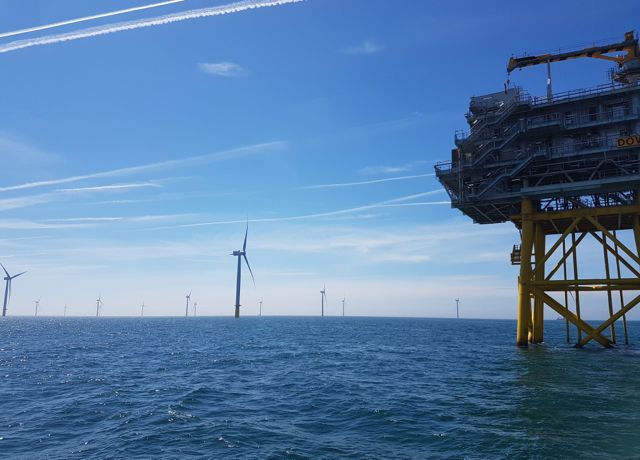
Integrating UK offshore renewables with oil and gas can reduce carbon emissions from fossil fuel production, a new report from the oil and gas regulator has concluded.
The Oil and Gas Authority’s (OGA) ‘UK Continental Shelf (UKCS) Energy Integration: Interim Findings’ study claims increased integration between offshore wind and other marine renewables and offshore oil and gas production can help deliver the UK’s net zero target.
The report cites technologies, such as carbon capture and storage (CCS), as well as green hydrogen production and storage, as critical in supporting decarbonisation.
The interim report discusses the first phase of the UKCS Energy Integration project which is led by OGA, working with the Department for Business, Energy and Industrial Strategy (BEIS), The Crown Estate and the energy regulator, Ofgem.
The project is considering options to help feed into a “new strategic vision” of the UKCS as an integrated energy basin. The project is funded by a grant from the Regulators’ Pioneer Fund.
OGA’s report finds that multiple offshore integration concepts are technically feasible and would be viable options for helping to lower the oil and gas industry’s carbon footprint and decarbonising the UK economy.
The report emphasises that opportunities for UKCS deployment are plentiful, diverse and location-specific.
Additionally, the UK has significant wind power potential, untapped carbon storage capacity, and extensive oil and gas infrastructure in place. All the concepts discussed in the report can reduce carbon dioxide emissions but differ in terms of scalability and timeline.
The concepts discussed in the report including platform electrification, which could “significantly reduce” emissions from offshore oil and gas installations by using clean electricity, including directly from offshore wind farms, to replace generation from gas and diesel. Technology for platform electrification has been proven and could enable near-term emissions reductions for the oil and gas industry.
Gas-to-wire (GtW) may also enable gas to be converted to electricity offshore and transported using existing windfarm cables. In terms of technical feasibility, individual elements are proven, but it is a niche solution suited, particularly, to the Southern North Sea (SNS) and East Irish Sea (EIS). GtW can to be combined with CCS to avoid the incremental carbon dioxide emissions.
CCS has already been piloted offshore and is considered essential in all UK decarbonisation scenarios, not just to decarbonise the power sector but also to enable deep cuts from other sectors, including industry. The storage potential across the UKCS and opportunity for oil and gas synergies is very significant.
Hydrogen has feasible production avenues through both ‘blue’ hydrogen (produced by natural gas reforming) and ‘green’ hydrogen (electrolysis produced by renewables) routes, enabling decarbonisation of power, heat and transport. The offshore energy sector – both oil and gas and renewables – offer significant production, storage and transport potential, for example through the repurposing of offshore oil and gas infrastructure and offshore electrolysis, with transportation in re-used pipelines.
Offshore energy hubs can meanwhile help scaling up net-zero energy solutions, for example, by allowing hydrogen to be generated offshore using wind farms and stored in reservoirs to be transported to shore using oil and gas infrastructure, according to the study.
OGA said it “fully supports the energy transition and welcomes the government’s legally binding commitment to net zero emissions by 2050”.
The regulator said it “understands why” there could be concern about UK domestic production of oil and gas in this context. However, oil and gas will remain an important part of our energy mix for the foreseeable future, including under net zero scenarios, where the UK is still expected to be a net importer. As such, managing the declining production and maximising the economic recovery from the UK remains vital to meet those energy demands as long as they exist, and to reduce reliance on hydrocarbon imports.
OGA chief executive Andy Samuel said: “The energy transition and the UK’s drive to net zero requires the oil and gas industry to embrace energy efficient operations, whilst supporting the growth of CCS, offshore renewables, and hydrogen.
“Our report highlights the wide range and combination of solutions that can play a part, in line with the Committee for Climate Change’s recommendations.
“Phase 2 is well underway, focusing on regulatory and economic aspects and we look forward to working closely with industry and government in enabling action through 2020 ahead of COP 26.”