


Orsted and a consortium of Danish companies have formed a landmark partnership to develop an industrial-scale transport fuel production facility in the Copenhagen area that will be powered by offshore wind in the Baltic Sea.
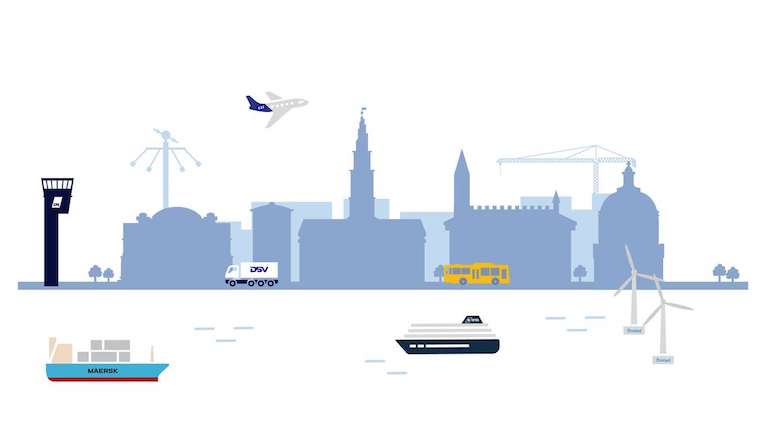
Copenhagen Airports, A.P. Moller – Maersk, DSV Panalpina, DFDS, SAS and the developer will bring together the demand and supply side of sustainable fuels with a vision to realise what could become one of the world’s largest electrolyser and sustainable fuel production facilities, they said.
If realised as envisaged, the project could supply renewable hydrogen for zero-emission buses tendered by Movia and heavy-duty trucks managed by DSV Panalpina, renewable methanol for A.P. Moller – Maersk vessels and renewable jet fuel (e-kerosene) for SAS airplanes and air transport out of Copenhagen Airports.
The project will require a large-scale supply of renewable electricity, which could potentially come from up to 1.3GW of offshore wind power produced at Rønne Banke off the island of Bornholm.
“Today, such sustainable fuels come at a higher cost than fossil-based fuels. To become competitive with fossil fuels, the production of sustainable fuels will need to be matured, built at industrial scale, and go through a cost-out journey similar to what has been seen over the past decade in other renewable energy technologies, such as offshore wind, onshore wind and solar PV,” the consortium said in a statement.
The group is set to develop ground-breaking hydrogen and e-fuel production facility as soon as 2023.
When fully scaled-up by 2030, the project could deliver more than 250,000 tonnes of sustainable fuel for buses, trucks, maritime vessels, and airplanes every year.
Production would potentially be based on a total electrolyser capacity of 1.3GW which would likely make it one of the world’s largest facilities of its kind.
The production from the fully scaled facility can reduce annual carbon emissions by 850,000 tonnes.
The electrolyser facility will not only be a potential cornerstone in decarbonising the partners’ businesses but will also deliver a critical contribution to reaching Denmark’s ambitious goal of reducing carbon emissions by 70% by 2030 compared to 1990 by replacing fossil fuels in heavy transport with sustainable fuels. The vision of the partnership is to develop the project in three stages.
The first stage, which could be operational by 2023, comprises a 10MW electrolyser which can produce renewable hydrogen used directly to fuel buses and trucks.
Stage two comprises a 250MW electrolyser facility which could be operational by 2027 when the first offshore wind power from Bornholm could be delivered. This facility would combine the production of renewable hydrogen with sustainable carbon capture from point-sources in the Greater Copenhagen area to produce renewable methanol for maritime transport and renewable jet-fuel (e-kerosene) for the aviation sector.
Stage three, which could be operational by 2030 when the offshore wind potential at Bornholm has been fully developed, would upgrade the project’s electrolyser capacity to 1.3GW and capture more sustainable CO2, enough to supply more than 250,000 tonnes of sustainable fuels to be used in buses, trucks, maritime vessels and airplanes.
The project has the potential to displace 5% of fossil fuels at Copenhagen Airport by 2027 and 30% by 2030.
The partnership will now move forward and engage in dialogue with the regulatory authorities on the framework and policies needed to support the development of using sustainable fuels at scale in the transport sector in Denmark, and to seek public co-funding to conduct a full feasibility study of the project.
If the feasibility study confirms the viability of the project vision, a final investment decision for the first stage of the project could likely be taken as soon as 2021.
CPH Airport Thomas Woldbye chief executive said: “The challenge of creating a future-proof and sustainable fuel is common to everyone in the transport sector, and the fact that we are now working together in a partnership is crucial for us to be able to produce sustainable fuel in the necessary quantities.
“It also supports the ambition to transition Danish aviation to become completely free of carbon emissions in 2050 and make Denmark a pioneer in the development of future climate-friendly fuels.”