


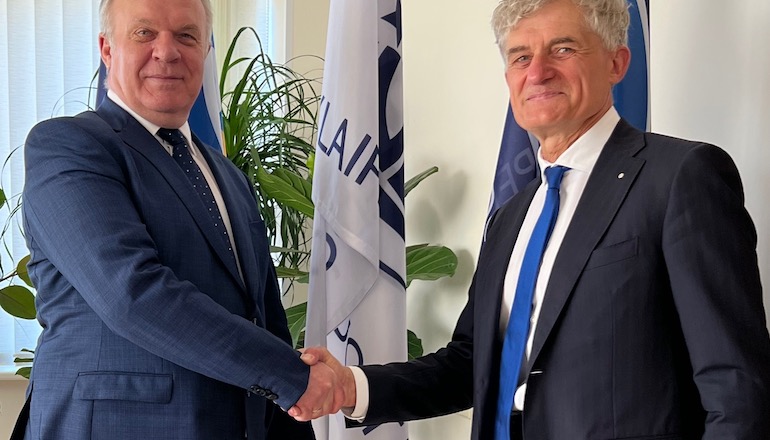
Klaipeda State Seaport Authority and Klaipeda Sea Cargo Company (Klasco) have signed an investment agreement to develop the port infrastructure required for the planned development of offshore wind farms off Lithuania.
Under the agreement, the Port Authority will provide the infrastructure on the Smelte peninsula to enable the development of production, assembly or storage activities for offshore wind power plants and components.
Quays will be reconstructed to accommodate the loading and assembly of turbines on about 20 hectares of land.
Klasco will build the relevant superstructure.
The investments in the infrastructure of the Smelte peninsula could amount to around €27m, the port said.
Klaipeda State Seaport Authority director general Algis Latakas (pictured, right) said: “The Port of Klaipėda is taking another step that will significantly contribute to strengthening Lithuania’s energy independence.
“This is the start of real work to attract an investor to a nationally important energy project – offshore wind power development.
“Diversifying activities and creating conditions for such activities in the port that create high added value is one of the goals of the Port Authority.
“The government’s decision to reduce the Port Authority’s average annual return on investment in wind energy infrastructure to 2% allows this investment to be implemented without placing a significant burden on future wind energy generation developers.”
Klasco chief executive Vytautas Stumbergas (pictured, left) said: “Offshore construction is a complex project. Bulky cargo will have to be unloaded, properly stored, assembled and transported by special vessels to the sea, where the wind turbines will be placed in the designated locations.
“We believe that most of this transshipment could be done by Lithuania through the Port of Klaipeda.
“Understanding the significance of such a project for the energy independence of Lithuania and the entire Baltic region, we are ready to contribute to the implementation of such an important project together with the Klaipeda State Seaport Authority.”