


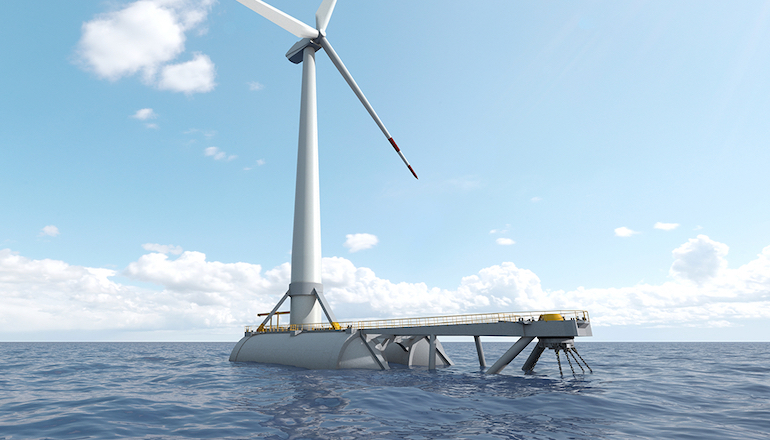
RWE is partnering with Offshore Renewable Energy (ORE) Catapult to study the potential for Scottish businesses to produce commercial-scale concrete foundations for floating wind projects.
Manufacture of concrete foundations could have the biggest supply chain benefit in terms of Scottish content for floating wind projects, said RWE.
For example, one concrete foundation for a 15MW floating turbine would have a mass in excess of 10,000 tonnes and a 500MW project would need around 33, offering an important opportunity for the local supply chain.
The study will be carried out by the ORE Catapult’s Floating Offshore Wind Centre of Excellence to understand the scale of this potential and how it might be unlocked.
RWE will fund the work and a summary will be published upon completion of the research in mid-2021.
RWE Renewables head of floating wind Chris Willow said: “Floating Wind could play an important part of the growth in offshore wind and has the potential to unlock new offshore wind markets around the world.
“RWE is progressing innovation in this growing sector as one of the world’s leading renewable companies.
“Concrete floating foundations have the potential to support Scottish projects and create local supply chain content, building on the country’s engineering legacy for a new generation of Scottish engineers.
“Achieving this will require collaboration between offshore wind developers like RWE, the Scottish Government and Scottish industry, which is why RWE has partnered with the ORE Catapult to investigate this important topic.”
ORE Catapult FOW CoE Programme Manager Ralph Torr said: “This report will identify key manufacturing and fabrication methodologies and constituent materials required to produce concrete substructures.
“It will also assess the existing Scottish supply chain capability and capacity to deliver such concrete substructures into a utility scale floating offshore wind project.
“Floating wind will be required to exploit a significant proportion of the deeper Scottish waters identified by Marine Scotland’s latest Offshore Wind Sector Marine Plan, and hence play a key role in Scotland achieving its Net Zero target by 2045.”
The knowledge gained from the three floating offshore demonstration projects RWE is participating in, provides an important source of information for future projects, the company said.
It is involved in the 2MW DemoSATH project (pictured), being developed in partnership with Saitec Offshore Technologies, is planned to be launched off the north coast of Spain in 2022.
The 12MW New England Aqua Ventus development, being developed in partnership with Diamond Offshore Wind and the University of Maine, is planned to be deployed in 2023 in the US off the coast of Maine.
RWE’s third floating demonstration project, using the steel TetraSpar concept, being developed in partnership with Stiesdal Offshore Technologies, Shell and TEPCO, is expected to be launched later in 2021.