


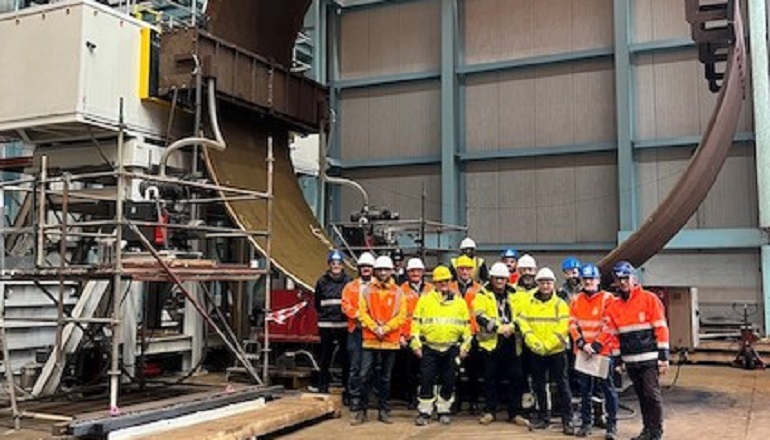
A collaboration between Sif, SSE Renewables, Cambridge Vacuum Engineering and TWI has resulted in the first-ever electron beam welded section to be incorporated in an offshore wind turbine monopile foundation.
The resulting monopile is set for installation later this year in the second phase of Dogger Bank Wind Farm, located more than 130km off the north-east coast of England.
Monopiles are typically fabricated using conventional techniques such as submerged arc welding (SAW), but the consortium has demonstrated that electron beam (EB) welding is “significantly quicker, cheaper, cleaner, more energy efficient and produces high quality welds with excellent fatigue properties”.
The type of EB welding technology used – called Ebflow – is an innovative development within the electron beam welding industry. Instead of welding inside a costly and size-limiting vacuum chamber, Ebflow uses a local vacuum system that creates and maintains a vacuum around only the seam that is being welded.
This technique opens up the potential to use EB welding on large structures, such as the biggest monopiles, while reducing costs and enhancing productivity. The technology – developed by CVE – has been shown to weld monopiles at least 25 times faster than current methods, while using 90% less energy, costing 88% less, and producing 97% less CO2 emissions than SAW methods.
The project required installation of an Ebflow system at Sif’s Maasvlakte 2 facility in Rotterdam to perform several longitudinal welds on 2750mm length seams on eight metre diameter rolled cans with a wall thickness of between 67mm to 85mm.
Qualification of the welding machine, weld procedures and operators were witnessed by third party inspectors and the regulatory body, DNV, which subsequently issued a technology qualification for EB welding and non-destructive testing (NDT) of the longitudinal seams produced with the process.
The comprehensive performance testing programme proved that Ebflow produces welds with fatigue strength that is at least as good, if not better, than observed in equivalent arc welded joints.
The resulting can was incorporated into a monopile transition piece in January 2023 and is scheduled to be installed offshore as part of a foundation in Dogger Bank Wind Farm in late 2023.
SSE Renewables project director for Dogger Bank Wind Farm Olly Cass said: “This is a ‘first-in-class’ project, establishing this UK innovation as a world-leading technology.
“With monopile type foundations accounting for over 90% of foundations used in UK projects, Ebflow RPEB could realise significant cost savings on future projects.
“These substantial savings will not only benefit the UK offshore engineering industry but could be passed on to UK energy consumers.”