


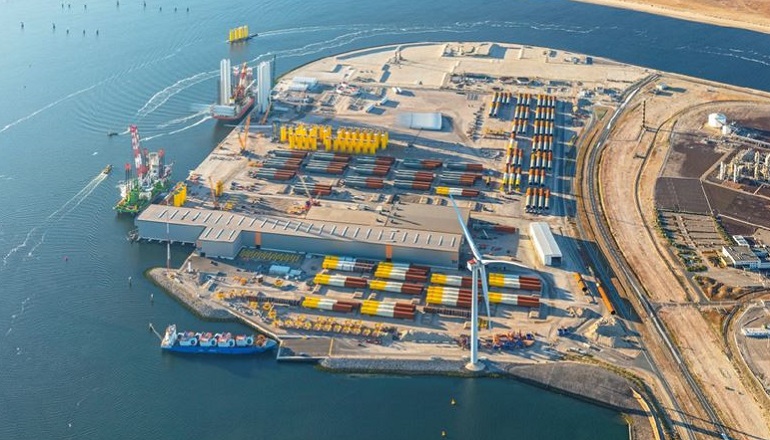
Dutch fabricator Sif has warned that the ramp-up of its new Maasvlakte 2 factory in Rotterdam will take six to nine months longer than planned, delaying full output until the first half of 2026.
Chief executive Fred van Beers said that more time was needed for workforce training, equipment stabilisation and improved working procedures at the expanded manufacturing site.
He said: “The time required to ramp up production will continue into the first half year of 2026. This results in lower output in 2025 than originally anticipated, and a delay of 6–9 months compared to the original business case.”
The factory delivered foundations for Empire Wind within specifications to meet the project’s installation window, while Sif’s Roermond facility produced transition pieces and top sections for Empire Wind 1, Ecowende and Baltyk.
Van Beers stressed that a stable, safe and high-quality production process takes priority over short-term EBITDA gains.
“Rather than focusing on the alternative of short-term EBITDA maximisation, our focus now is achieving robust and stable operations, and taking the time needed to implement the right industrialisation measures,” he said.
Adjusted EBITDA for the first half of 2025 fell to €12.9m, down from €26.1m in the same period last year. Revenue rose to €258m compared with €231m in 2024, with contributions of €64m from offshore wind foundations, €10.6m from offshore structures and €5.4m from other services.
Sif has revised its full-year adjusted EBITDA outlook for 2025 to €45m. However, it reiterated its target of at least €160m annualised run-rate EBITDA from 2026, with provisional minimum guidance of €135m for that year.
The company produced 80 kilotonnes of steel foundations in the first half of 2025, including 44 monopiles and 34 transition pieces, compared with 86 kilotonnes in 2024.
Manufactured foundations in the period will result in 529MW of renewable capacity, down from 773MW last year.
Van Beers said Sif is strengthening its operations organisation with a new chief operating officer, while the current COO focuses on the technical completion of the ramp-up plan.
External specialists and equipment suppliers are also supporting a significant process modification programme to stabilise production at Maasvlakte 2.
He added that while near-term conditions for offshore wind remain challenging, Sif sees improving fundamentals from 2028 onwards.
“We remain confident in the medium to long-term outlook for the offshore wind market but expect a further offshore wind project development slowdown short term mainly due to non-market conform tender criteria, grid congestion and prices for electricity,” he said.
Sif’s order book stood at 625 kilotonnes at the end of August, up from 435 kilotonnes a year earlier. This includes a 200 kilotonne addition for 2027 and 2028, which has moved from preferred status to exclusive negotiations.
Van Beers concluded: “Our confidence in the medium to long-term outlook for the offshore wind market is further underpinned by this addition to the orderbook. Based on the actual progress of the actions being undertaken and the output during the second half of 2025, we will provide further guidance towards the end of the year.”