


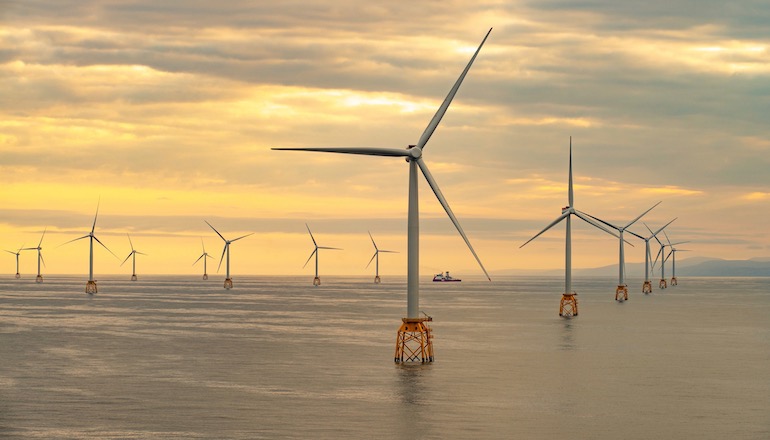
Crown Estate Scotland has awarded option agreements to 17 projects totalling almost 25GW in its ScotWind offshore wind lease auction.
ScottishPower Renewables is the largest single winner having been awarded the seabed rights to develop three new offshore wind farms, including two new floating wind farms being developed in conjunction with Shell.
The projects comprise the 3GW MarramWind and 2GW CampionWind joint ventures with Shell for two floating projects off the north-east and east coasts respectively.
SPR also secured the 2GW MachairWind fixed foundation scheme off the coast of Islay, which the Scottish developer is pursuing alone.
BP landed 2.9GW for a fixed foundation wind farm in partnership with German player EnBW.
The two will develop the Morven project in a 860km square lease area located around 60km off the coast of Aberdeen.
SSE Renewables in partnership with Maurbeni and CIP, meanwhile, landed 2.6GW in a 858 square km zone that will support the development of a new giant floating offshore wind farm.
The seabed is in the E1 Zone in the Firth of Forth off the Angus Coast and is one of the largest lease areas to be offered by Crown Estate Scotland to any bidder in the ScotWind process, said the companies.
Other winners include DEME with 2GW of fixed and floating wind farms and Offshore Wind Power, a joint venture between Macquarie’s Green Investment Group , TotalEnergies and RIDG (15%), with 2GW.
The latter secured rights in the N1 area to develop a 2GW offshore project dubbed West of Orkney.
Ocean Winds won the NE4 site off the north-east coast and has named the 1GW project the Caledonia wind farm.
The site lies in the outer Moray Firth to the East of Scotland’s largest wind farm, the Moray East offshore wind farm, which Ocean Winds began developing in 2010 and whose commercial operational date is expected at the beginning of 2022.
Vattenfall and Fred Olsen Seawind notched a 798MW success for a project 67km off the east coast.
The Floating Energy Allyance of BayWa r.e., Belgian devloper Elicio and floating wind pioneer BW Ideol secured 960MW for the area designated NE8, located some 75km to the northeast of Fraserburgh on the Aberdeenshire coast.
The JV expect to enter into an Option Lease Agreement with Crown Estate Scotland by April 2022.
Norwegian developer Magnora Offshore Wind won 495MW in the north-western part of Scotland, 40km off the Western Isles.
The project will cover an area of approximately 100 square kilometres in water depths of 106 to 125 metres, and the concept base for the application is 33 semi-submersible floating wind turbines of 15MW capacity.
Falck Renewables landed 2.7GW for floating projects; two with BlueFloat Energy and a third which will be developed in a consortium with BlueFloat and Orsted.
The projects with BlueFloat are one situated east of Aberdeen at the E1 site and second at a site north of Fraserburgh in the NE6 zone.
The third development that includes Orsted is east of Caithness in the NE3 region.
The winning projects were selected out of a total of 74 applications, and have now been offered option agreements which reserve the rights to specific areas of seabed.
A total of just under £700m will be paid by the successful applicants in option fees and passed to the Scottish government for public spending.
The area of seabed covered by the 17 projects is just over 7000km square (a maximum of 8600km square was made available through the Scottish government’s Sectoral Marine Plan),
Initial indications suggest a multi-billion pound supply chain investment in Scotland, added Crown Estate Scotland.
Crown Estate Scotland chief executive Simon Hodge said: “Today’s results are a fantastic vote of confidence in Scotland’s ability to transform our energy sector. Just a couple of months after hosting COP26, we’ve now taken a major step towards powering our future economy with renewable electricity.
“In addition to the environmental benefits, this also represents a major investment in the Scottish economy, with around £700m being delivered straight into the public finances and billions of pounds worth of supply chain commitments.
“The variety and scale of the projects that will progress onto the next stages shows both the remarkable progress of the offshore wind sector, and a clear sign that Scotland is set to be a major hub for the further development of this technology in the years to come.”
Should any application not progress to signing a full agreement, the next highest scoring application will instead be offered an option.
Once these agreements are officially signed, the details of the supply chain commitments made by the applicants as part of their Supply Chain Development Statements will be published.
This is just the first stage of the long process these projects will have to go through before turbines go into the water, as the projects evolve through consenting, financing, and planning stages, Crown Estate Scotland said.
Responsibility for these stages does not sit with Crown Estate Scotland, and projects will only progress to a full seabed lease once all these various planning stages have been completed.