


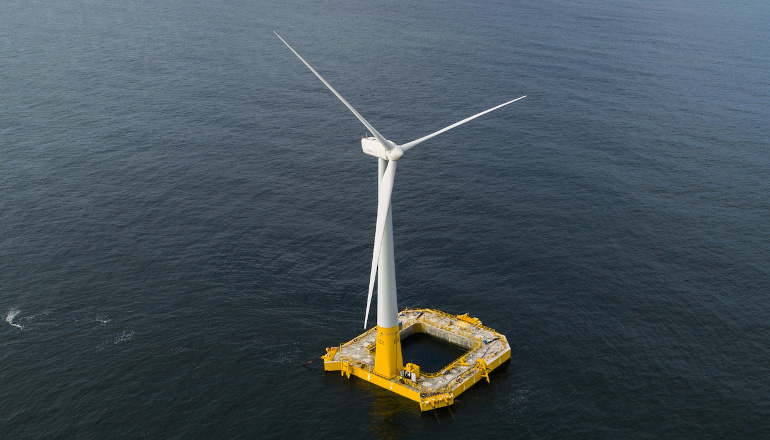
The floating offshore wind industry needs to proactively address potential hazards to prepare for future large-scale deployment, according to a new report released by the G+ health and safety organisation.
Supported by ERM’s The Renewables Consulting Group, Tadek, and European Marine Energy Centre, the G+ Floating Offshore Wind Hazard Identification (HAZID) report identifies specific risks associated with a typical commercial-scale floating wind farm.
It also recommends best safety practices and tools for its members and the broader offshore wind industry.
To evaluate critical areas and potential bottlenecks for a commercial-scale floating wind farm, the study assumed a wind farm of circa 50 semi-submersible platforms with 15MW wind turbines.
In collaboration with the industry, risk items were identified for the three periods of operations during a typical floating offshore wind project lifecycle.
Notably, the study highlighted key gaps in industry guidance for constructing and operating floating offshore wind projects.
These include the risk of the novel technology being deployed in markets with no offshore experience and regulatory frameworks.
The report’s authors caution that the relatively small-scale FOW deployment to date has meant that, where there are FOW specific requirements, they mostly focus on design considerations (such as structural requirements) rather than occupational health and safety (H&S).
Therefore, a significant opportunity exists to proactively develop guidelines covering occupational H&S as early as possible in the design phase.
Dan Kyle Spearman, Director and Global Lead on Floating Offshore Wind at The Renewables Consulting Group, said: “By combining health and safety data, insights from existing projects and our in-depth understanding of health and safety in the global wind industry, we have been able to consider the risks and challenges associated with the deployment of floating offshore wind projects.
“As floating wind projects ramp up globally, the industry needs to proactively tackle the health and safety challenges to prepare effectively for future large-scale deployment.”