


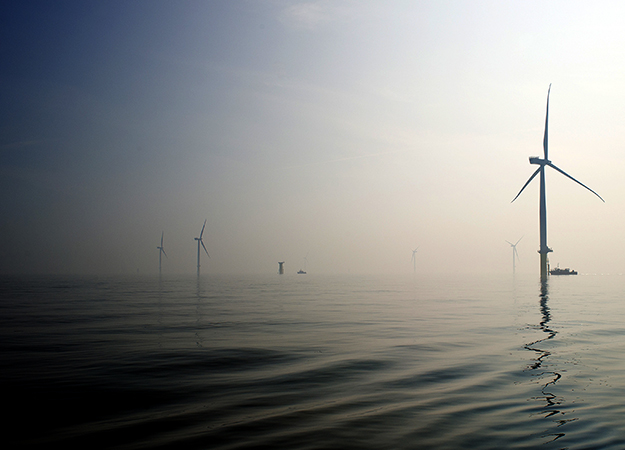
Only 20% of China’s current pipeline of offshore wind farms will be connected to the grid by the end of 2021 because of local supply chain limits, according to research by Wood Mackenzie.
Some 45GW of projects have been approved to receive a feed-in tariffs (FiT) before 2022, after which the FiT rate will be cut as tenders gradually step in, Wood Mackenzie said.
“The overwhelming pipeline strengthens the long-term outlook, but also puts more pressure on the local supply chain than it can handle,” said Wood Mackenzie senior analyst for power and renewables research Xiaoyang Li.
She said that a lack of supply chain and installation equipment won’t be able to support provincial governments’ ambitions in the short term.
“Bottlenecks in vessel supply are the main barrier to project delivery from 2019 to 2021,” Li added, with only a few purpose-built wind installation vessels in operation in the domestic Chinese market.
However, despite the bottlenecks, Wood Mackenzie expects 10.8GW of new capacity to come online during the installation rush from 2019 to 2021.
In 2022, the market will then see new additions dip by one-third when the FiT level reduces, compared with the previous year, Li said.
“But new additions will soon rebound to their normal level given China’s huge market size and offshore potential, with an average of more than 4GW of annual capacity additions from 2023 to 2028,” she said.
In total, 40.4GW of offshore wind capacity is expected to be grid-connected from 2019 to 2028, according to Wood Mackenzie.
The provinces of Guangdong and Jiangsu will lead the market growth, with approximately 85% of project capacity that is planned or under construction, it said.
Li said that given the “growing momentum” in the sector, China could meet the 5GW target outlined by its National Energy Agency in the 13th five-year plan covering 2015 to 2020.
She added that offshore wind remains the country’s most expensive energy in the near term, with the average levelised cost of electricity (LCOE) is expected to drop from RMB646 a megawatt-hours in 2019 to RMB409/MWh in 2028.
“Developers will face earnings pressure when subsidies start to decline after 2021, and the offshore wind project LCOE will not drop below the provincial coal power FiT until 2028,” she said.