


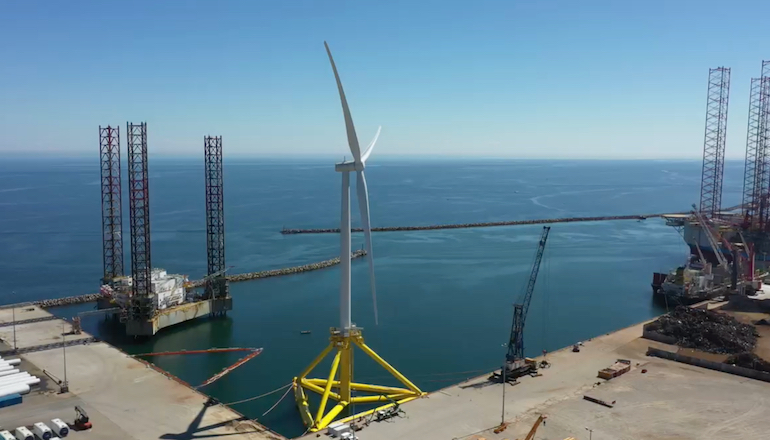
Shell and RWE have commissioned Swiss company Akselos to use structural simulation software Integra to model the TetraSpar floating foundation demonstrator, which will be installed offshore Norway later this year.
Akselos’ software will help accelerate the demonstration of the industrialised offshore foundation.
The ‘Digital TetraSpar’ will interface with sensors on the structure and act as a detailed, holistic structural model of the demonstrator.
The aim is to provide insights to drive further improvements in the design and operation of the concept, resulting in lower cost, optimised maintenance, and inspection workflows, among many other benefits.
Akselos VP customer success Michiel van Haersma Buma said: “This is a hugely exciting project to be involved in.
“Commercialisation of floating offshore wind, which is vital to our ability to meet the targets set by the Paris Agreement, is hampered by the high cost of existing designs and subsequently operating them.
“The TetraSpar concept could completely change that and, by using Integra, the developers will be able to further optimise design and accelerate validation.
“That will, in turn, be key to get the concept to market sooner.”
Shell offshore wind project engineer Steven Zijp said: “Shell is focused on identifying and developing the next generation technologies to help accelerate the energy transition.
“The partnership between Akselos, TetraSpar, RWE and Shell enables us to further scale and manage floating offshore wind turbines, making them safer and more cost efficient, while allowing developers access to deeper and more challenging waters around the world.”
This is the second floating wind win for Akselos, with a structural digital twin already deployed on the WindFloat Atlantic project as part of a US Department of Energy grant.
The TetraSpar floating wind foundation was developed by Stiesdal Offshore Technology, founded by Danish inventor Henrik Stiesdal.
It is being developed by Stiesdal Offshore Technology, Tepco Renewable Power, Shell, and RWE. The project will be installed 13km from the coast at the Marine Energy Test Centre, near Stavanger, southeast Norway.