


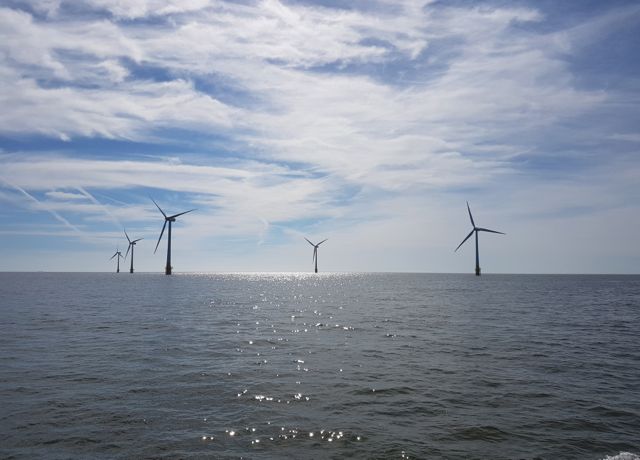
The wind energy transmitted from the German North Sea by grid operator Tennet amounted to over 16 terawatt hours in 2018, a new record.
The 16.75 terawatt hours result exceeded 2017’s amount of 15.97 terawatt hours by 4.9%.
Measured against the total wind output of Germany of 106.45 terawatt hours, comprising offshore and onshore wind, the North Sea wind contribution achieved a healthy share of 15.7%.
Tennet managing director Wilfred Breuer said: “It was foreseeable that the increase in the transmitted quantity of wind energy from sea to land in 2018 would be less pronounced than in previous years.
Making it all the more important to further accelerate the grid expansion on land in order to have the grid capacities on land needed to transport the electricity to the consumption-heavy regions of western and southern Germany as soon as possible.”
Tennet is developing and participating in numerous innovative approaches and projects involving smart future technologies, digitalisation of the electricity grid, increasing of its flexibility and advancing the coupling of the different sectors.
“We are aiming at planning security and greater cost efficiency,” said Breuer.
One current innovative approach in the offshore area is the planned 66 kilovolt technology that will be used for connecting the offshore wind farms to the future Tennet connections of DolWin5 and BorWin5.
To date Tennet has connect 11 offshore grid connection systems with a joint capacity of 6.2GW for offshore wind energy transmission from sea to land.
Breuer added: “With this, TenneT has now almost entirely achieved the federal government’s expansion goal of having 6500MW of offshore wind capacity by 2020.
“Already this year, TenneT will exceed this goal since the completion of BorWin3 in the course of 2019 will put a total of 7123MW of transmission capacity into operation in the North Sea alone.”
By the end of 2023, another connection system in the form of DolWin6 will be added, which will bring the available transmission capacity in the North Sea up to 8GW.
The technology can reduce investment cost and operational expenses by millions since the offshore transformer platforms of the wind farms are no longer needed and significantly less cable is required for connecting the individual wind turbine systems.
The current maximum infeed performance of offshore wind farms in the North Sea reached 4773MW on 15 December 2018.
The capacity expansion for offshore wind farms in the North Sea was at 5307 MW on 31 December 2018.
The wind turbines in the Baltic Sea, which are outside the Tennet grid area, generated 2.35 terawatt hours in 2018, which means Germany’s total offshore yield amounted to 19.1 terawatt hours. With an additional 87.35 terawatt hours of generated onshore wind energy, the total yield is 106.45 terawatt hours.